
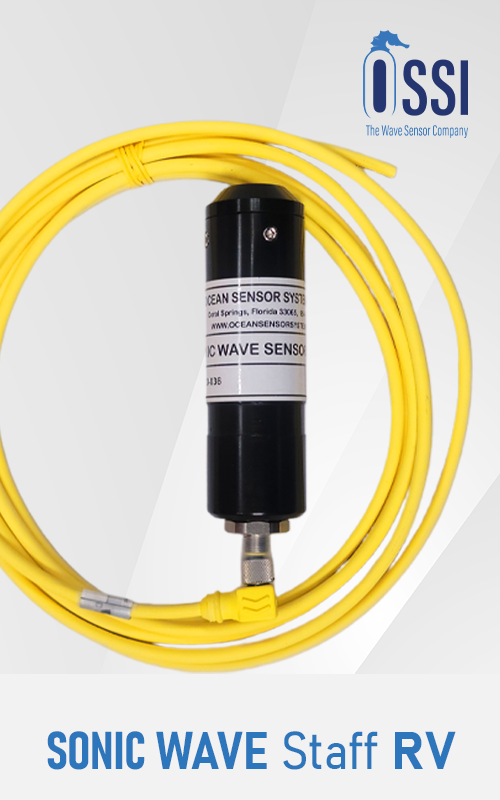
Sonic Wave Sensor RV (OSSI‑010‑036)
Wired Ultrasonic Wave & Water-Level Sensing
An ultrasonic non-contact wave and water-level monitoring sensor with RS232/RS485 communication and optional analog output for marine, coastal, laboratory, and industrial applications
Executive Summary
Accurate measurement of wave height, tide variation, and water-surface displacement is essential across coastal engineering, hydrodynamic laboratories, environmental monitoring, flood warning systems, tank and reservoir monitoring, and marine infrastructure assessment. Traditional contact-based sensors often suffer from corrosion, fouling, and mechanical wear in marine environments — limitations that the Sonic Wave Sensor RV addresses through a non-contact ultrasonic measurement approach.
The Ocean Sensor Systems Sonic Wave Sensor RV (OSSI-010-036) is an ultrasonic non-contact wave and water-level monitoring sensor that combines ultrasonic sensing, anti-aliasing filtering, synchronized sampling, and flexible communication interfaces inside a rugged IP67-rated package designed for harsh environments.
The sensor supports wave, tide, and water-level measurements with a maximum operating range of 2.5 meters and provides submillimeter wave measurement capability. It is available with RS232 or RS485 communication, optional 0–5 V analog output, and supports synchronized arrays of up to 8 sensors on a single RS485 network.
Product overview
The Sonic Wave Sensor RV measures wave motion and water elevation without contacting the water surface. The manufacturer datasheet identifies the following core feature set:
- ✓Ultrasonic non-contact sensing — measurements taken without any submerged element.
- ✓IP67 waterproof housing — full dust ingress and immersion protection.
- ✓Anti-aliasing sensing circuit — automatic 64 Hz internal filter improves signal quality.
- ✓RS232 or RS485 communication — point-to-point or multi-drop multi-sensor networking.
- ✓Optional 0–5 V analog output — direct integration with PLC, SCADA, and DAQ systems.
- ✓Configurable sample rates — six selectable rates from 1 Hz to 32 Hz.
- ✓Continuous or burst sampling modes — match acquisition strategy to power and data budget.
- ✓Time-tagged synchronized data — every sample marked with the on-board RTC.
- ✓Real-time clock synchronization — host-driven time alignment across the array.
- ✓Automatic calibration — supplemented by optional 12-point in-situ calibration.
- ✓Submillimeter wave measurement — 0.1 mm resolution in binary float mode.
- ✓Up to 8 synchronized sensors — on a single RS485 network for spatial array studies.
Operating principle
The Sonic Wave Sensor RV operates using the ultrasonic time-of-flight principle. The sensor emits an ultrasonic pulse toward the water surface and measures the return echo time. Distance is calculated from the speed of sound in air and the measured round-trip travel time:
// d = distance to water surface
// c = speed of sound in air
// t = round-trip travel time (½ factor compensates for round trip)
Why non-contact matters: Because the sensor never touches the water, it avoids the four most common failure modes of contact-based wave gauges — making the OSSI-010-036 a strong fit for long-term marine and industrial deployments where maintenance access is limited.
- ✓No biofouling — no submerged surface for marine growth to accumulate on.
- ✓No corrosion — particularly valuable in saltwater and aggressive industrial fluids.
- ✓No mechanical wear — no moving parts in contact with the measured medium.
- ✓No electrical exposure to water — improves long-term reliability and safety.
Technical specifications
The OSSI-010-036 delivers submillimeter resolution alongside a wide power input range and flexible sampling — making it equally well-suited to laboratory bench setups, industrial control panels, and remote solar-powered installations.
Configurable sampling rates:
Sensor variants
The Sonic Wave Sensor RV is available in six factory configurations covering the combinations of communication interface, analog output, and accuracy class. The "E" suffix indicates an enhanced-accuracy variant.
| Model | Interface | Analog Output | Accuracy |
|---|---|---|---|
| OSSI-010-036-1 | RS485 | 0–5 V | ±0.25% FS |
| OSSI-010-036-2 | RS232 | 0–5 V | ±0.25% FS |
| OSSI-010-036-3 | RS485 | None | ±0.25% FS |
| OSSI-010-036-1E | RS485 | 0–5 V | ±0.10% FS |
| OSSI-010-036-2E | RS232 | 0–5 V | ±0.10% FS |
| OSSI-010-036-3E | RS485 | None | ±0.10% FS |
Choose the RS485 variants for multi-sensor arrays and longer cable runs; RS232 variants for simple point-to-point host integration; and the "E" enhanced variants when laboratory-grade accuracy is required.
Wave performance zones & anti-aliasing
The datasheet divides the operating range into five performance zones (A–E) classified by wave-steepness tolerance. Selecting the correct zone for your application is essential to achieving expected accuracy.
High-resolution waves
Highest wave-steepness tolerance for fast wave measurement.
Steepness: 0.114Wave & tide
Combined wave and tide monitoring at moderate distances.
Steepness: 0.083Wave & tide
Mid-range wave and tide measurement.
Steepness: 0.067Wave & tide
Longer sensor-to-water distances with reduced steepness tolerance.
Steepness: 0.042Tides only
Lower dynamic response, primarily suited to tide measurement.
Tide-only modeExcessive wave steepness may temporarily cause lost samples. During such conditions, the sensor outputs the last valid reading until a new valid sample is detected — preserving data continuity for the host system.
Automatic anti-aliasing filter: When enabled, internal sampling occurs at 64 Hz with rate-matched averaging. At an 8 Hz configured output rate, 16 internal measurements are averaged and the output updates every 125 ms — significantly improving signal stability, spectral analysis quality, and wave-height consistency. The manufacturer recommends configuring the sample rate at least 8× higher than the highest expected wave frequency.
Communications & data formats
The Sonic Wave Sensor RV supports both digital and analog interfaces, giving deployment engineers flexibility to match the host data acquisition system.
Point-to-point digital
Single-sensor link to PC, embedded controller, or data logger — simplest configuration for one-sensor deployments.
Multi-drop networking
Supports synchronization of up to 8 sensors on one differential network — ideal for spatial wave arrays and long cable runs.
0–5 V output (optional)
Direct integration with PLC systems, SCADA platforms, DAQ systems, and industrial controllers via analog ground reference.
Time-tagged records
10 PPM on-board RTC with PC time synchronization — every sample carries a timestamp suitable for multi-sensor correlation.
The sensor supports four data output formats, each suited to a different host integration pattern:
| Format | Description | Best for |
|---|---|---|
| ASCII 1 sample | Continuous single sample | Terminal programs, simple loggers |
| ASCII 32 samples | Buffered ASCII block | Bandwidth-efficient ASCII pipelines |
| Float 32 samples | Binary floating-point | Full 0.1 mm resolution for analysis |
| Integer 64 samples | Binary integer | Maximum throughput on long campaigns |
Each record includes device ID, sample rate, battery status, timestamp, and wave samples:
Calibration system & user software
The Sonic Wave Sensor RV supports both factory calibration and in-situ user calibration. Up to 12 calibration points can be configured for enhanced accuracy across the full measurement range.
Typical multi-point calibration positions span the working range:
Enhanced-accuracy models can achieve approximately 0.05% full-scale calibration performance under controlled conditions — making the RV suitable for laboratory precision studies.
Sonic & Staff Product Interface Program: The included PC software provides a complete ecosystem for configuration, visualization, and analysis — eliminating the need for separate tools.
- ✓Real-time plotting — live trace visualization for one or multiple sensors.
- ✓Spectral analysis — wave spectra, significant wave height, frequency-domain plots.
- ✓Data logging — record live streams to disk for post-processing.
- ✓Device configuration & calibration setup — set sample rate, format, filter, and multi-point calibration.
- ✓Wave-height & mean water level analysis — built-in statistics for engineering reporting.
Applications & installation
The Sonic Wave Sensor RV is well-matched to coastal engineering, hydraulic research, flood monitoring, and industrial liquid-level applications — particularly where non-contact measurement and wired multi-sensor synchronization are valuable.
Coastal engineering
Coastal wave monitoring, harbor wave studies, breakwater testing, and tide monitoring — leveraging high accuracy and multi-sensor RS485 synchronization.
Wave tanks & laboratories
Hydrodynamic laboratories, university wave flumes, CFD validation studies, and coastal research facilities — submillimeter resolution supports demanding precision work.
Flood monitoring
River monitoring, stormwater channels, bridge clearance monitoring, and reservoir level tracking — supporting real-time flood-management decisions.
Industrial applications
Tank level measurement, wastewater monitoring, chemical process monitoring, and water treatment systems — non-contact design avoids corrosion and contamination.
Recommended installation practices for optimal sensor performance:
- ✓Maintain a clear ultrasonic path — keep the beam zone free of obstructions to ensure consistent echo return.
- ✓Avoid nearby reflective structures — walls, beams, and pipes near the beam can cause spurious echoes.
- ✓Install above maximum water level — the sensor must remain dry across the full operating range.
- ✓Use RS485 for multi-sensor systems — differential signaling supports longer cable runs and noise rejection.
- ✓Enable anti-aliasing for wave studies — leverage 64 Hz internal filtering for clean spectral content.
- ✓Select sample rates based on expected wave frequencies — follow the 8× rule for the highest wave frequency of interest.
Benefits, limitations & conclusion
Non-contact operation
Eliminates corrosion, sensor contamination, and biofouling — significantly reducing maintenance frequency over long deployments.
High resolution
0.1 mm float-mode resolution and ±0.10% FS enhanced accuracy support laboratory precision studies and CFD model validation.
Flexible power input
Wide 4–45 V DC range covers solar systems, battery banks, and industrial power supplies without auxiliary regulators.
Multi-sensor synchronization
Up to 8 sensors on a single RS485 network supports directional wave studies, spatial wave analysis, and multi-point monitoring arrays.
Rugged environmental design
IP67 housing withstands rain, dust, and incidental immersion — suitable for harsh outdoor and marine environments year-round.
Automatic anti-aliasing
64 Hz internal filtering with rate-matched averaging delivers clean, low-noise wave records straight from the sensor.
Operational considerations:
- !Range restriction: The 2.5 m maximum range may limit use in deep reservoirs, high bridge installations, or offshore deep-water applications.
- !Atmospheric sensitivity: Performance may be influenced by heavy rain, spray, wind turbulence, and temperature gradients — installation should consider these factors.
- !Wave steepness limits: Breaking or extremely steep waves may result in intermittent sample loss; the sensor reports the last valid reading until valid data resumes.
The Sonic Wave Sensor RV (OSSI-010-036) is a specialized ultrasonic wave and water-level sensor designed for high-resolution marine and industrial measurements — combining high accuracy, submillimeter resolution, flexible RS232/RS485/analog communications, anti-aliasing filtering, multi-sensor synchronization, and rugged IP67 environmental protection. These capabilities make it highly suitable for coastal engineering, wave laboratory research, tide monitoring, environmental sensing, and industrial level measurement. Its ability to provide synchronized, high-frequency, non-contact measurements offers significant advantages over conventional contact-based water-level sensors in demanding marine and industrial environments.