
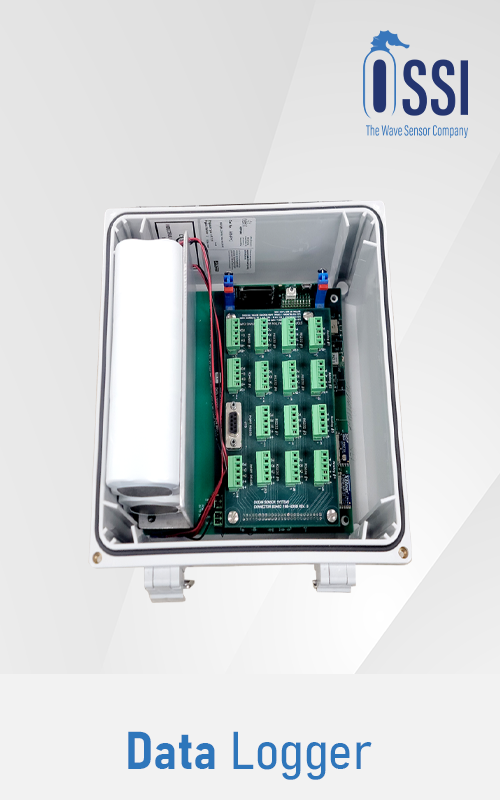
Data Logger (OSSI‑012‑015)
Oceanographic & Environmental Monitoring
Advanced multi-sensor data acquisition, logging, and telemetry platform for oceanographic and environmental monitoring
Executive Summary
Modern environmental and coastal engineering projects demand continuous, high-quality measurements from geographically distributed sensors — often in remote, harsh, or unmanned locations. Meeting these demands requires more than simple local data storage; it requires synchronized acquisition, reliable communications, flexible power management, and edge processing in a single ruggedized platform.
The OSSI-012-015 combines data acquisition, edge processing, communications, sensor power management, and telemetry into a single enclosure optimized for harsh marine and environmental conditions.
The Ocean Sensor Systems Data Logger (OSSI-012-015) is a rugged, field-deployable environmental monitoring platform designed for synchronized acquisition, storage, and transmission of oceanographic, hydrological, meteorological, and industrial sensor data.
The platform is particularly suited for coastal engineering projects, wave measurement systems, environmental monitoring stations, offshore research deployments, port and harbor monitoring, marine construction projects, flood and storm surge observation, and remote telemetry installations.
Why environmental data loggers?
Modern environmental monitoring systems require continuous collection of high-quality measurements from geographically distributed sensors. Engineers and researchers increasingly require accurate timestamps, multi-sensor synchronization, long-term storage, remote accessibility, low maintenance, and reliable operation in harsh environments.
Environmental monitoring projects often fail due to the following critical shortcomings — all of which the OSSI-012-015 directly addresses:
- ✓ Inaccurate timing and poor inter-sensor synchronization leading to data correlation errors
- ✓ Communication failures in remote or offshore locations cutting off real-time access
- ✓ Power interruptions during unattended long-term deployments
- ✓ Corrupted or lost data storage due to inadequate file management systems
- ✓ Overly complex maintenance procedures requiring frequent site visits
System architecture
The OSSI-012-015 is built around six tightly integrated subsystems that work together to deliver reliable, synchronized, long-term monitoring from a single compact enclosure:
Sensor Interface
Analog, RS232, RS485, XBee wireless, Wave Staff, and Sonic Wave Sensor connectivity.
Processing
Embedded microcontroller for acquisition, sensor polling, timestamp generation, frame construction, and telemetry management.
Timing
Real-time clock with GPS synchronization, automatic time correction, and ±2 ppm long-term stability.
Storage
SD card storage with automatic directory management, sequential file generation, and up to 9,999 files per directory.
Communications
RS232, RS485, Bluetooth, XBee, and optional 900 MHz RF modem supporting simultaneous logging and telemetry.
Power Management
Dual 8–36 V DC inputs supporting battery, solar, and external DC power for fully autonomous remote operation.
Hardware & sensor interfaces
The logger is housed in a UV-resistant polyester NEMA 4X enclosure (approx. 4″ × 8″ × 8″) with hinged industrial access — providing full protection against rain, salt spray, dust, UV exposure, and corrosion for unattended coastal or offshore deployments.
The four programmable analog channels accept both bipolar (±10.24 V down to ±0.64 V) and unipolar (10.24 V down to 1.28 V) ranges, enabling integration with pressure transducers, water level sensors, weather sensors, current meters, turbidity sensors, temperature probes, and conductivity sensors.
XBee wireless sensor support enables wireless Wave Staff and Sonic Wave Sensor integration — reducing cable costs, simplifying deployment, and improving site flexibility without sacrificing synchronized acquisition.
Timing & data acquisition
Accurate time-stamping and inter-sensor synchronization are fundamental to wave analysis, coastal hydrodynamics research, and structural monitoring. Even a few seconds of timing error can significantly affect data correlation across spatially distributed sensors.
- ✓GPS synchronization: Integrated GPS receiver provides automatic clock correction and long-term timing stability at ±2 ppm — ensuring accurate timestamps between synchronization events.
- ✓Maximum sample rate: Up to 32 Hz across all connected sensors — suitable for wave measurements, water level monitoring, structural vibration, and environmental process monitoring.
- ✓Continuous sampling: Full-resolution recording for real-time monitoring and event detection applications.
- ✓Burst sampling: Periodic measurement mode dramatically reduces power consumption — essential for solar-powered and battery-operated remote deployments.
Data integrity is maintained through structured API frames with start delimiters, length verification, escaped control characters, and checksum verification — particularly valuable for long-range RF communications where packet loss or interference may occur.
Storage & telemetry
The OSSI-012-015 supports simultaneous local storage and real-time telemetry — providing redundancy and operational flexibility that conventional single-mode loggers cannot match.
SD card — removable flash
Large capacity, low cost, standard PC compatibility. Auto directory creation with sequential files (DLOG0001.DAT … DLOG9999.DAT) for large monitoring campaigns.
RS232 / RS485 streaming
Real-time data streaming via wired serial while simultaneously logging to SD card — full redundancy with no performance penalty.
Bluetooth local access
Cable-free configuration, diagnostics, and data retrieval within short range — ideal for temporary research deployments and field maintenance.
900 MHz — up to 65 miles
Optional 1 W RF modem for offshore stations, harbor entrances, barrier islands, and remote coastal observation sites. Line-of-sight dependent.
The dedicated OSSI Interface Program provides configuration, real-time wave visualization, sensor diagnostics, historical data review, SD card processing, and data export — significantly reducing deployment complexity in the field.
Power system
Remote coastal and offshore deployments often have no access to mains power. The OSSI-012-015 is designed from the ground up for autonomous long-term operation in these environments.
Dual power inputs
Two independent 8–36 V DC inputs enabling power redundancy, seamless switchover between solar and battery, and flexible hybrid power configurations.
Solar-ready operation
Compatible with optional 10 W solar panel and 12 V battery system for continuous remote power — enabling year-round unattended deployments at isolated coastal sites.
Burst mode power savings
Burst sampling mode dramatically reduces overall power consumption, extending battery life for deployments where continuous 32 Hz acquisition is not required.
Surge & corrosion protection
Recommended deployment practice includes surge protection, corrosion-resistant hardware, and elevated mounting — protecting electronics at exposed marine sites.
Engineering applications
The OSSI-012-015 was specifically designed around Ocean Sensor Systems' Wave Staff technologies, giving it native, optimized support for coastal and nearshore monitoring applications alongside its generic multi-sensor capability.
Synchronized multi-staff wave measurement for nearshore studies, breakwater design, harbor engineering, and sediment transport research.
Beach nourishment monitoring, shoreline change studies, storm impact assessments, and long-term sea level observation at fixed monitoring stations.
Real-time environmental data acquisition for port authorities and marine construction contractors — supporting safety decisions, scheduling, and structural monitoring.
Environmental monitoring for offshore wind, marine energy research, cable route surveys, and environmental compliance monitoring at offshore installations.
Continuous high-frequency water level monitoring for flood forecasting, storm surge tracking, and real-time emergency management systems.
Key benefits
GPS-synchronized timing
Integrated GPS receiver with ±2 ppm clock stability ensures accurate timestamps and reliable inter-sensor synchronization across all channels.
Multi-interface integration
4× analog, 8× RS232, 2× RS485, Bluetooth, and XBee wireless — integrating virtually any combination of wired and wireless sensors from a single hub.
Dual logging & telemetry
Simultaneous SD card storage and real-time RS232, Bluetooth, or RF telemetry provides redundancy and live data access without compromise.
Long-range RF telemetry
Optional 900 MHz, 1 W RF modem with up to 65-mile line-of-sight range — supporting remote offshore stations and barrier island monitoring sites.
Solar-ready remote power
Dual DC inputs with optional 10 W solar panel and 12 V battery package for truly autonomous, long-term unattended deployments at isolated sites.
Rugged NEMA 4X enclosure
UV-resistant polyester housing rated for rain, salt spray, dust, and UV — built to remain unattended for months or years in coastal and offshore environments.
Conclusion
The Ocean Sensor Systems Data Logger (OSSI-012-015) is more than a conventional data logger — it is a complete environmental monitoring platform that combines sensor integration, GPS-synchronized acquisition, real-time telemetry, local storage, and autonomous power management into a single rugged system. Its native support for Wave Staff and Sonic Wave Sensor technologies, simultaneous logging and telemetry architecture, long-range 900 MHz RF communications, and solar-compatible dual power inputs make it an outstanding choice for coastal engineering, oceanographic research, port and harbor monitoring, and remote environmental observation. For organizations requiring reliable, high-quality, long-term environmental data from the field — with minimal maintenance and maximum deployment flexibility — the OSSI-012-015 delivers a highly capable solution that balances field reliability, integration depth, and operational efficiency.