
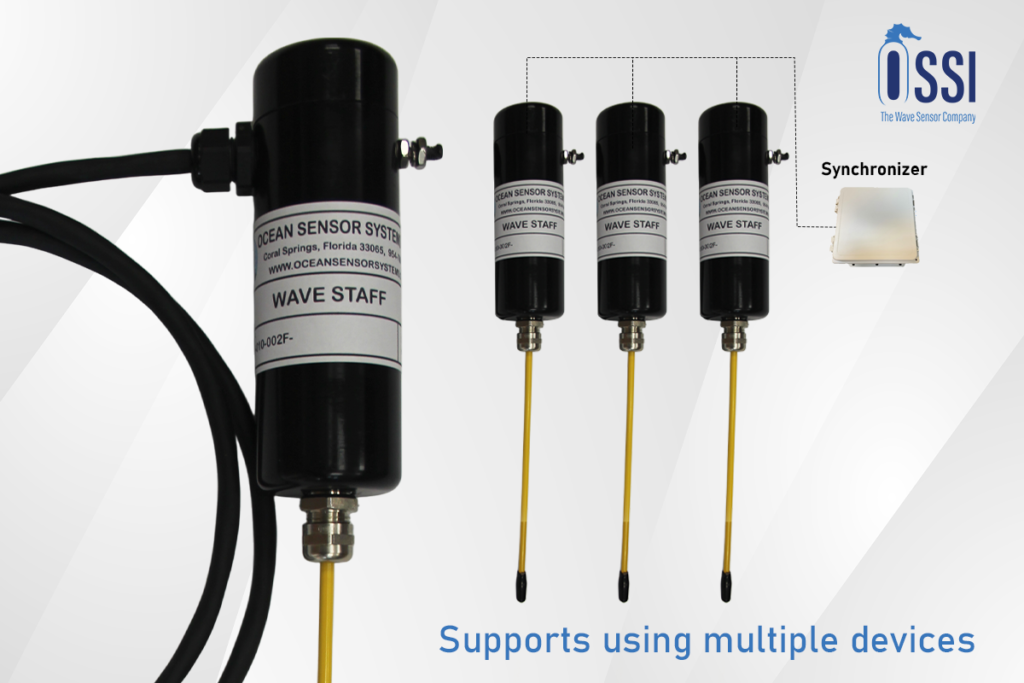
Wave Staff (OSSI‑010‑002F)
Coastal & Hydraulic Engineering
Advanced wave and water level monitoring for coastal, port, and hydraulic structures
Introduction
Coastal and hydraulic infrastructure — including bridge approaches, marine terminals, locks, spillways, piers, and harbor works — must function in environments dominated by waves, wakes, tides, and rapidly varying water levels. These conditions directly influence structural loading, temporary works stability, vessel access, and worker safety.
Engineers increasingly rely on high-resolution, real-time water level measurements taken at or near the structure itself, rather than at distant tide gauges or model-derived estimates. Direct contact wave staffs are among the most robust, field-proven technologies available for capturing free-surface elevation data in these demanding environments.
The Ocean Sensor Systems Wave Staff (OSSI-010-002F) is a contact-type wave and water level sensor used in wave tanks, coastal research, near-shore deployments, and hydraulic structures worldwide.
Why high-frequency monitoring?
During construction and operation of near-shore and hydraulic infrastructure, free-surface conditions affect multiple critical factors. Conventional tide gauges or offshore buoys often lack the spatial resolution or frequency response needed within a confined construction zone.
- ✓ Design and verification of wave and current loads on foundations, cofferdams, and retaining works
- ✓ Stability of scaffolding, falsework, access platforms, and floating equipment
- ✓ Vessel approach conditions for barges, tugs, ferries, and construction craft
- ✓ Scheduling tidal access windows for heavy lifts, concrete placements, or diving operations
- ✓ Performance evaluation of energy dissipation structures, armor layers, and wave-calming features
Product overview
The Wave Staff OSSI-010-002F is a high-resolution water level sensor designed for direct measurement of liquid surface height. Key characteristics at a glance:
Extended temperature version available: −40 °C to +65 °C. Staff material: PTFE-coated rod or cable (interchangeable).
Technical performance
The Wave Staff's electronics combine a low-power microprocessor with a temperature-stable sensing circuit to deliver high measurement quality across a wide dynamic range.
The high analog update rate (up to 110 Hz) is particularly important for resolving short-period wind waves, boat wakes, and rapid transients — all common in harbor and construction environments.
Sync mode: "Sample on command" operation allows simultaneous sampling across staff arrays using external TTL pulses or serial commands — enabling directional wave analysis or spatial wave characterization along a structure.
The unit also reports integrated air temperature via its serial output:
- ✓Temperature resolution: ~0.0625 °C per count — supports concrete curing monitoring and environmental documentation
- ✓Temperature accuracy: ±0.5 °C over the standard operating range
Outputs & alarms
The Wave Staff integrates multiple output channels in a single sealed unit — one device that can serve simultaneously as a high-resolution sensor, alarm trigger, and serial data source.
0–5 V output
Direct connection to analog input modules or data loggers. Guaranteed accuracy from ~8 mV to 4.9 V with ≥5 kΩ load.
RS232 — 9600 baud, 8-N-1
ASCII or binary format, transmitting water level counts and optional air temperature data in real time.
Open-drain output
Programmable high/low threshold. Up to 350 mA with 60 V inductive load clamping. Drives relays, beacons, or PLCs.
Open-drain output
Second independent threshold channel — enables dual-level control such as pump start/stop or multi-stage warning systems.
Deployment strategies
The interchangeable staff system allows the same electronics module to be adapted to many deployment scenarios. Staff selection depends primarily on site depth and tidal range.
Rod staffs — fixed near-shore
Ideal for bridge piers, abutments, jetty faces, quay walls, and wave flume test frames where water depth and tidal range are modest. Rigid geometry suits localized wave run-up and overtopping monitoring.
Cable staffs — deep or variable
Up to 20 m for offshore pier approaches, ferry terminals, tidal estuaries with large level excursions, and deep wave basins. Same electronics head — different staff only.
Grounding requirements
Unlike coaxial designs, the Wave Staff requires a dedicated ground wire from the ground stud to a submerged electrode. Maintain ~4 inches clearance from metallic surfaces to avoid measurement interference.
Mounting orientation
Mount vertically, projecting downward into the fluid from piers, piles, bridge structures, or dedicated frames. Electronics housing remains above the splash zone at all times.
System integration
The Wave Staff is designed for straightforward integration into modern data acquisition, control, and SCADA systems.
- ✓RS232 configuration: Configurable via Ocean Sensor Systems software or any generic terminal program (9600 baud, 8-N-1). Commands control start/stop, configuration read/write, and unit ID query. Serial acknowledgments (STOK, WOK, ROK) confirm successful communication.
- ✓PLC / SCADA connection: The 0–5 V analog output connects directly to PLC analog input cards, providing a low-latency, high-rate water level signal for control or protective functions.
- ✓Synchronization: External TTL sync pulses or serial commands enable near-simultaneous sampling across multi-sensor arrays — ideal for directional or spatial wave studies.
- ✓Alarm integration: Programmable trip points (Drain1On/Off, Drain2On/Off) in the configuration string drive safety beacons, automated gates, pumps, or valve operations.
Engineering applications
By deploying Wave Staffs at key locations, engineers can couple measured environmental forcing with structural response data for a complete understanding of load paths and safety margins.
Track wave run-up and freeboard at temporary or permanent coastal structures during all construction staging phases.
Monitor tide and water level windows for barge operations, heavy lifts, concrete placements, and diver access at bridge and pier projects.
Evaluate dynamic responses of cofferdams, sheet pile walls, and temporary platforms to wave and wake forcing.
Support wave transformation, reflection, and structure interaction studies in hydraulic laboratories using rod staffs on fixed test frames.
Provide real-time inputs to safety alarms and automated systems — triggering pumps, beacons, gates, or valve operations at coastal and hydraulic infrastructure.
Key benefits
Improved safety
Real-time wave and water level visibility with on-board programmable alarm outputs for worker and equipment protection.
High temporal resolution
Up to 110 Hz analog and 30 Hz serial rates for detailed wave, wake, and transient event analysis.
Proven measurement quality
±0.25% accuracy over the central range, 0.025% resolution, and ±0.5% linearity across the full scale.
Deployment flexibility
Interchangeable staffs up to 20 m, rod and cable configurations, and wide 5.5–40 V power input range.
Integration ready
Dual 0–5 V and RS232 outputs plus programmable alarms simplify connection to existing loggers, PLCs, and SCADA systems.
Low lifecycle cost
Sealed electronics with staff-only replacement when geometry changes or damage occurs — minimizes downtime on multi-year projects.
Conclusion
For near-shore, harbor, riverine, and hydraulic infrastructure projects that demand accurate, high-frequency water level and wave monitoring, the Ocean Sensor Systems Wave Staff (OSSI-010-002F) offers a robust, field-proven solution. Its combination of rugged construction, interchangeable PTFE staffs up to 20 m, high-rate analog and RS232 outputs, and programmable alarm capability makes it an excellent fit for both research-grade measurements and construction or operations monitoring. By placing Wave Staff sensors directly on or near critical structures — bridge piers, quay walls, cofferdams, and test frames — engineers can capture localized wave and water level conditions with the fidelity required for modern coastal and hydraulic design, construction management, and safety assurance.