
Technical White Paper for Long-Term Wave, Tide, Wake, and Water-Level Monitoring
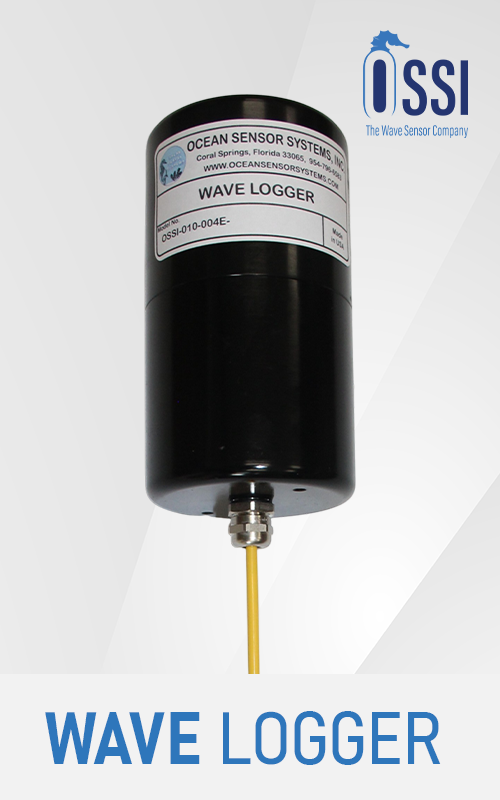
Wave Logger (OSSI‑010‑004)
Long-Term Wave, Tide, Wake & Water-Level Monitoring
A capacitive wave staff data logger system for coastal monitoring, hydraulic engineering, laboratory wave flumes, and environmental research
Executive Summary
Coastal engineering investigations, harbor monitoring programs, hydraulic laboratory experiments, and inland water studies all require accurate, high-resolution measurement of free-surface elevation — often over weeks, months, or years of unattended deployment. Conventional pressure-based wave gauges infer surface motion from subsurface measurements, introducing phase lag, hydrostatic corrections, and dependence on assumed water density.
The OSSI-010-004 takes a different approach: a capacitive wave staff that measures the water surface directly, paired with an onboard data logger, CompactFlash storage, internal battery power, and programmable acquisition software inside a rugged waterproof enclosure.
The Ocean Sensor Systems Wave Logger (OSSI-010-004) is a self-contained wave and water-level monitoring system designed for long-duration unattended deployments, providing direct surface elevation measurements with high accuracy, low power consumption, and flexible sampling configurations.
Direct capacitive sensing minimises signal distortion and improves capture of short-period waves, vessel wakes, laboratory-generated wave trains, and rapidly changing water-level conditions — making the system particularly well-suited to coastal engineering, laboratory wave tanks, harbor monitoring, inland water studies, and environmental observation programs.
Product overview
The OSSI-010-004 integrates four major subsystems into a single field-ready instrument — eliminating the need for external power systems, telemetry equipment, or dedicated field computers for many monitoring applications.
Sensing Subsystem
Capacitive wave staff constructed from Teflon-coated rods or cables measures instantaneous water-surface elevation directly.
Data Acquisition Subsystem
Low-power microprocessor digitizes measurements at programmable sample rates between 2 Hz and 30 Hz with 12-bit resolution.
Data Storage Subsystem
Records onto industry-standard FAT16 CompactFlash cards up to 2 GB capacity in either ASCII or binary format.
Power Management Subsystem
Four C-cell alkaline batteries provide months of continuous sampling or years of burst-mode deployments.
Technology & measurement principle
The OSSI Wave Logger uses a capacitive wave staff that functions as a variable capacitor. As water level rises and falls along the staff, the wetted length changes — which alters the electrical capacitance measured by the Wave Logger electronics. This capacitance change is converted into digital water-level data with 12-bit resolution across a 0–4095 count range.
Why direct surface measurement matters: Capacitive wave staffs measure the actual water-air interface rather than inferring it from pressure beneath the surface — delivering measurements that hydraulic laboratories and coastal engineering research facilities have widely adopted as a reference standard.
- ✓High-fidelity wave capture — short-period waves and steep wave crests are recorded with minimal attenuation.
- ✓Minimal phase lag — the sensor responds immediately to surface motion, unlike subsurface pressure sensors that depend on transfer-function corrections.
- ✓No hydrostatic correction required — readings are independent of mounting depth and instrument burial.
- ✓No water density assumptions — measurements are valid across fresh, brackish, and salt water without recalibration.
- ✓Improved measurement of steep waves and vessel wakes — making the logger especially useful in laboratory flumes and harbor wake studies.
Technical specifications
The OSSI-010-004 combines precision sensing electronics with ultra-low-power design for reliable long-term operation. Performance figures below correspond to the manufacturer's published datasheet values.
Interchangeable Teflon-coated wave staffs are available in two construction types covering measurement spans from laboratory flumes to deep tidal environments. An external grounding rod or grounding plate connection establishes the reference for the capacitive sensing circuit.
| Staff type | Length range | Typical use |
|---|---|---|
| Teflon rod | 1–5 m | Laboratory flumes, shallow nearshore, harbor structures |
| Teflon cable | 6–20 m | Deep coastal sites, large tidal ranges, deep wave basins |
Optional integrated air-temperature measurement provides 0.0625 °C resolution with ±1.25 °C accuracy (−10 °C to +65 °C), and ±2.15 °C in the extended-temperature version (−40 °C to +65 °C).
Data management architecture
The OSSI-010-004 supports two storage formats — selectable by the user to balance human readability against storage efficiency and deployment duration.
Human-readable text
Easily imported into spreadsheets, simple troubleshooting, compatible with most engineering software. Up to ~388 million samples on a 2 GB CF card.
High-efficiency packed format
Higher storage efficiency, longer deployment duration, reduced file size, faster data handling. Up to ~936 million samples on a 2 GB CF card.
The Wave Logger automatically manages data files with no user intervention required during long deployments — up to 512 files per card, time-stamped headers, embedded configuration metadata, and burst-event markers throughout the record.
// automatic sequential naming, headers, metadata, burst markers
- ✓Industry-standard FAT16 on CompactFlash up to 2 GB — readable on any standard PC with a CF card reader.
- ✓Automatic naming sequence — no manual file management needed in the field.
- ✓Embedded configuration metadata — each file carries the deployment context with it.
- ✓Burst-event markers — burst boundaries are flagged in the record for downstream analysis.
Data processing workflow
From surface detection to engineering analysis, the OSSI-010-004 follows a clear seven-step pipeline that requires no specialist infrastructure beyond a CF card reader and a PC.
Surface detection
The capacitive staff continuously measures changes in water contact height along the Teflon-coated sensing element.
Analog conversion
The capacitance signal is converted into 12-bit digital counts ranging from 0 to 4095.
Sampling
Measurements are captured at the programmed sample frequency between 2 Hz and 30 Hz in continuous or burst mode.
Data formatting
Records are assembled into ASCII or binary format with time and date stamps from the on-board real-time clock.
Storage
Records are written to the CompactFlash memory card with automatic file naming and configuration headers.
Retrieval
Users remove the CompactFlash card and transfer files to a PC for processing using any standard CF card reader.
Analysis
Data is processed for wave height statistics, spectral analysis, wake characterization, water-level trends, tidal analysis, and laboratory model validation.
Deployment strategies & engineering applications
The interchangeable staff system and battery-powered architecture support a wide range of deployment scenarios — from controlled laboratory environments to multi-month coastal monitoring campaigns.
Laboratory wave flumes
One of the strongest deployment scenarios — wave generation studies, reflection analysis, transmission studies, breakwater testing, physical model validation. Multiple staffs can be installed along a flume to evaluate wave propagation and energy dissipation.
Coastal infrastructure monitoring
Mount on piers, jetties, pilings, harbor structures, or navigation facilities for wave climate assessment, harbor agitation studies, vessel wake monitoring, and shoreline project evaluation.
Inland water monitoring
Lakes, reservoirs, retention ponds, rivers, and environmental monitoring stations — leveraging the low-power architecture for unattended multi-month observation programs.
Research programs
Coastal process studies, sediment transport investigations, hydrodynamic model validation, instrument calibration programs, and surface elevation reference measurements for universities and research institutions.
Across these deployment categories, the Wave Logger supports several specific engineering workflows:
Significant wave height, wave periods, wave energy, and seasonal wave variability for long-term coastal characterization.
Harbor resonance analysis, dock design studies, and vessel safety evaluations using directly measured surface elevation records.
Breakwater design, seawall assessments, and beach nourishment monitoring with high-fidelity wave data adjacent to structures.
Validation of SWAN models, CMS-Wave simulations, Delft3D studies, and laboratory scale model results against measured surface elevations.
Battery life & long-term monitoring
A significant strength of the OSSI-010-004 is its ultra-low power architecture — enabling unattended deployments measured in months or years rather than days.
The datasheet includes battery-life models based on sample frequency, burst duration, and burst interval — allowing users to estimate deployment duration before field installation and to tune their sampling strategy against expected power budget.
Benefits & limitations
The OSSI-010-004 brings clear strengths to fixed-location wave and water-level monitoring — alongside operational considerations that prospective users should weigh against their site and application.
High measurement fidelity
Direct capacitive surface sensing provides highly accurate wave representation with no pressure-to-surface transfer function required.
Extremely low power
3 mW sleep and ~6.8 mW at 20 Hz continuous — ideal for remote and unattended deployments lasting months to years.
Flexible sensor lengths
Staff lengths from 1 m rods to 20 m cables cover laboratory flumes, harbor structures, and deep tidal environments alike.
Self-contained design
No external power, recorder, or telemetry hardware required — one enclosure delivers sensing, logging, storage, and power management.
Simple data retrieval
Standard CompactFlash technology and FAT16 file system simplify field operations and PC-based processing.
Programmable acquisition
Users tune sample rate, burst length, and burst interval to optimize each deployment for the project's data and power requirements.
Operational considerations to weigh against the application:
- !Fixed installation required: The system mounts to a stable structure — it is not a free-drifting or directional sensor.
- !Grounding requirement: A water grounding rod or plate must be installed to establish the capacitive measurement reference.
- !Exposure to fouling: Marine growth, debris, and ice on the sensing staff can affect performance over long deployments.
- !Point measurement: The instrument measures a single location — not an area or directional wave field.
- !Legacy storage technology: CompactFlash remains reliable but is less common than modern SD-card-based logging systems.
Consider alternatives when: Offshore deployments are required, directional wave spectra are needed, non-contact measurements are preferred, or severe surf-zone exposure is expected. Organizations with existing fixed infrastructure such as piers, flumes, docks, or pilings will realize the greatest value from the OSSI-010-004.
Conclusion
The Ocean Sensor Systems OSSI-010-004 Wave Logger is a robust, field-proven wave and water-level monitoring solution that combines direct capacitive surface measurement, ultra-low-power operation, onboard CompactFlash storage, and flexible deployment options into a single integrated package. Its ability to collect months of continuous data or years of burst-mode data makes it particularly attractive for coastal engineering investigations, harbor monitoring, hydraulic laboratory experiments, reservoir and inland water studies, and environmental observation programs. For organizations seeking a reliable, accurate, and cost-effective method of measuring surface elevation in fixed-location deployments — backed by ±0.25% central-range accuracy, 12-bit resolution, programmable 2–30 Hz sampling, and interchangeable staff lengths from 1 m to 20 m — the OSSI-010-004 remains a technically sound solution whose strengths in accuracy, durability, programmability, and long-term autonomous operation make it a valuable instrument for both engineering projects and scientific research programs.