
Executive Summary
This white paper follows the solution-oriented structure of the provided sample white paper, but all product-specific technical claims are grounded in the OSSI-010-003C Wave Gauge datasheet rather than the Wave Staff III example. The result is a marketing-technical paper that remains engineering-credible, positioned for technical managers, coastal engineers, marine contractors, and infrastructure owners evaluating autonomous wave-monitoring options.
The OSSI-010-003C is best understood as a recoverable, autonomous pressure-based wave recorder for fixed-point marine deployments. According to the datasheet, it combines a stable pressure sensor, a CompactFlash data logger, a rugged waterproof housing, and either 12 or 28 C-cell alkaline batteries; it stores up to 2 GB of time- and date-stamped data in ASCII or binary format, supports programmable sampling from 2 to 30 Hz, operates in either burst or continuous mode, offers ±0.05% FS accuracy from 10 to 40°C, is rated to 100 m depth, includes optional water-temperature logging, and is configured through RS232. The same datasheet also states that current C-version units can operate for months continuously and years in burst mode, depending on duty cycle and battery pack choice.
Pressure-based wave gauges remain a practical and widely used class of instruments because they are rugged, compact, and well suited to fixed installations on the seabed or on marine structures, especially in ports, harbors, marine-operations sites, and coastal research settings. At the same time, published literature is clear that pressure-derived wave statistics require thoughtful post-processing, because the wave signal attenuates with depth and can become biased in deeper water or over rough bathymetry if correction methods are weak or poorly parameterized.
For buyers and operators, the OSSI-010-003C’s strongest value proposition is not flashy telemetry or onboard analytics. It is dependable autonomous logging at a fixed point, with flexible duty cycling, standard removable media, straightforward serial configuration, and performance appropriate for coastal engineering, port monitoring, shallow-offshore infrastructure support, wave-energy site characterization, and site-specific research where recoverable raw data are more important than real-time dashboards. Its main tradeoffs are equally clear: no directional wave capability is specified, no native telemetry is specified, and the burden of pressure-to-wave conversion and QA/QC sits with the user’s processing workflow.
Introduction
Coastal and offshore projects increasingly require wave observations that are local, continuous, and operationally trustworthy. That need spans coastal engineering studies, port and harbor operations, offshore fixed and floating asset support, marine renewable energy assessments, and environmental research. Recent review literature notes that accurate wave measurements are essential for estimating environmental conditions, quantifying wave-induced loads on fixed and floating platforms, validating numerical models, and improving operational decisions in the marine sector.
In shallow water, the practical menu of wave-sensing approaches is well established: buoys, surface-piercing instruments, and bottom-mounted sensors. NOAA’s national wave-observation planning documents note that shallow-water monitoring often relies on buoys, bottom-mounted pressure or acoustic sensors, and, less often, surface-piercing gauges attached to fixed structures near shore or on offshore platforms and towers. Pressure-based sensors therefore occupy a useful middle ground: less exposed than a surface buoy, more rugged than a surface-piercing staff, and often easier to mount at a known datum near the structure or site of interest.
That positioning is exactly where the OSSI-010-003C belongs. The datasheet presents it as a self-powered, self-logging pressure sensor package designed to record raw pressure time series to removable CompactFlash media for later PC-based analysis. This is a highly practical architecture for infrastructure projects that need reliable field endurance, straightforward setup, and a recoverable primary record that can be reprocessed as analytical requirements evolve.
Industry Challenge
The industry challenge is not merely collecting wave data. It is collecting the right wave data at the right location for long enough to support design, construction, operations, or research decisions. Published work on low-cost and bottom-mounted wave sensors emphasizes that remote offshore buoys and numerical hindcasts often fail to represent local microsites, especially in topographically complex nearshore settings shaped by reefs, headlands, canyons, bays, or man-made structures. Field observations taken at the site of interest can materially improve interpretation of local forcing conditions.
Pressure-based gauges work by measuring fluctuations in the pressure exerted by the overlying water column. In routine practice, those pressure records are converted to sea-surface elevation using linear wave theory, a transfer function that depends on water depth and the sensor’s height above the bed. This is a mature approach, and widely implemented tools exist for it, but it comes with a known physical constraint: the pressure signature of a wave attenuates with depth, and attenuation increases with frequency. The deeper the sensor and the shorter the wave period, the more heavily the signal must be corrected.
That limitation is not academic. In a 2024 study on rough rocky bathymetry off the Monterey Peninsula, co-located bottom-mounted pressure sensors and wave buoys showed that pressure-based significant wave height squared could overestimate buoy observations by as much as 21% when standard local-depth assumptions were used; a spatially smoothed bathymetry improved the depth correction and reduced those errors. In a separate deployment under a CDIP surface buoy at Cabrillo Point, a bottom-mounted pressure logger still correlated strongly with the co-located buoy for significant wave height, but discrepancies remained, particularly where deeper mounting amplified attenuation-correction sensitivity.
For technical managers, the implication is simple. A pressure-based wave logger can be an excellent asset, but it must be treated as a measurement system, not just a sensor. Instrument choice, pressure range, deployment depth, sensor elevation above bottom, atmospheric correction strategy, burst scheme, file handling, and post-processing governance all affect the final engineering value of the data.
Product Overview
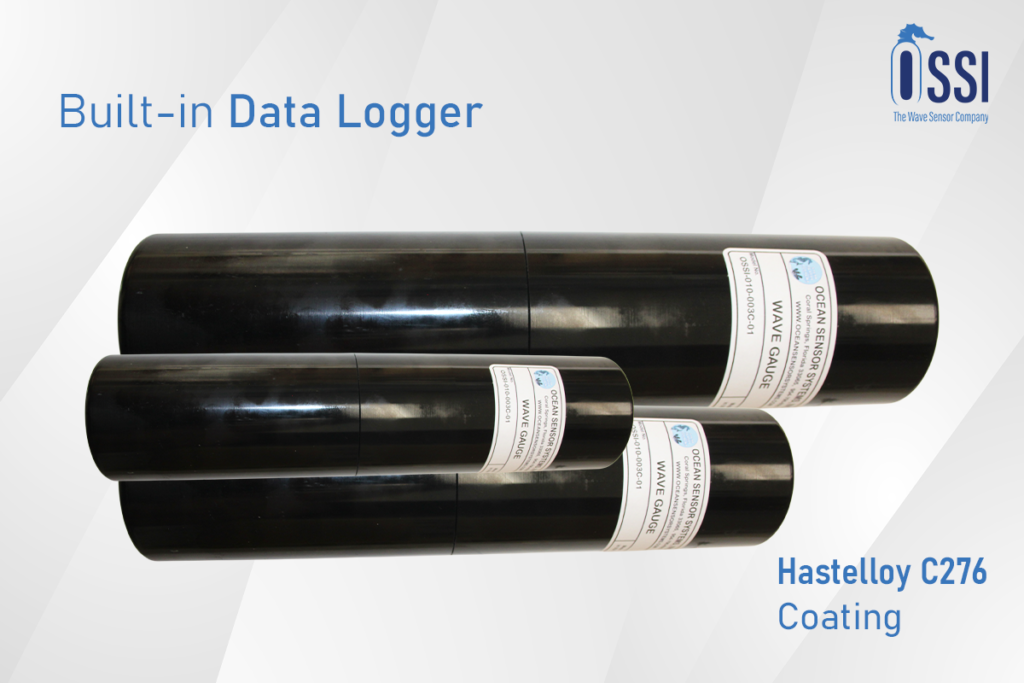
The OSSI-010-003C is a compact autonomous wave gauge built around a stable pressure sensor, a low-power microprocessor, onboard CompactFlash storage, and an internal battery pack. The datasheet lists 0–1 bar, 0–3 bar, and 0–10 bar versions for the C series, plus extended-case versions with a larger 21 V, 28-cell battery pack. Standard features include CF-based storage up to 2 GB, binary or ASCII file formats, programmable 2–30 Hz sample rate, burst or continuous sampling, a flush Hastelloy diaphragm, ABS housing rated to 100 m, RS232 programmability, PC interface software, optional water-temperature logging, ±0.05% FS accuracy from 10 to 40°C, 0.0033% FS resolution, and ±0.05% FS long-term stability.
Architecture is where the OSSI makes its strongest operational case. The unit is genuinely self-powered and self-logging: once configured, it records directly to CompactFlash with embedded time and date, and the card can be removed and read on a standard PC card reader. The timing and interfacing section of the datasheet specifies 64 MB to 2000 MB FAT16 CF support, 9.6 kbaud serial communication, programmable burst lengths and intervals from 1 to 60 minutes, a new-file interval out to 255 days, and a real-time clock accuracy of 20 ppm. At the top end, a 2 GB card is rated for approximately 468 million samples in binary format or 232 million in ASCII. The logger can create up to 512 files, and each file header stores configuration metadata such as sample frequency, burst parameters, date, time, and pressure range.
Power performance is similarly transparent. The datasheet reports typical battery life for the current C-version packs of about 3.0 months continuous sampling with the 18 V, 12-cell pack and 6.5 months with the 21 V, 28-cell extended pack. At a 25% sample duty cycle, those typical values increase to 9.7 and 21.7 months, and at a 10% duty cycle to 17.8 and 40.3 months, respectively. The same documentation provides mission-planning formulas for both drain power and storage time, which is unusually useful from an operations standpoint. It also notes a practical limitation at the high end: to achieve 30 Hz, either serial output or air-temperature logging must be disabled.
Representative current competing solutions show that the market has diversified around the same core trade space: self-contained recovery loggers, integrated wave/tide sensors, and hybrid real-time pressure systems. Across those product types, published specifications range from packetized or burst-derived wave outputs to up to 16 Hz raw pressure sampling, from compact 64 KB memories to 4 GB SD platforms or roughly 240 million readings, from about ±0.02% to ±0.1% FS accuracy, and from shallow coastal depth ratings around 30–90 m to deep-ocean recorder classes. That breadth means direct comparisons must be read carefully, but it also makes the OSSI’s niche clear: a straightforward recoverable coastal logger with unusually high published sampling flexibility for its class.
| Spec | OSSI-010-003C | Typical competing solutions |
|---|---|---|
| Core architecture | Self-powered, self-logging pressure recorder with removable CompactFlash media | Self-contained logger, integrated wave/tide sensor, or real-time pressure gauge; some use SD/cloud or cabled backhaul instead of removable CF |
| Onboard storage | Up to 2 GB CF; approx. 468M binary or 232M ASCII samples at 2 GB | Roughly 64 KB and ~21.7k samples in compact loggers to 4 GB SD platforms or ~240M readings in larger recorders |
| Sampling capability | Programmable 2–30 Hz; burst or continuous | Commonly 2–16 Hz raw sampling, or lower-frequency burst/parameter-update modes |
| Accuracy | ±0.05% FS from 10–40°C; ±0.1% FS over -10 to 65°C | Commonly around ±0.02% to ±0.1% FS, depending on instrument class |
| Ruggedness | ABS housing rated to 100 m; flush Hastelloy diaphragm | Shallow/coastal wave-tide products commonly around 30–300 m; deeper BPR families can extend to 2000–6000+ m |
| Battery endurance | Months continuous; years burst; datasheet gives duty-cycle formulas and typical month-scale examples | From months to multi-year field life depending on sample duty cycle, battery chemistry, and whether telemetry is active |
| Interface and data | RS232 configuration; ASCII or binary files; PC card reader workflow | RS232/RS422/CANbus/USB/optical/SD/cloud/API workflows |
| Temperature | Optional water-temperature logging | Often integrated or optional, with varying accuracy and logging granularity |
The technical advantages that matter most in deployment are the OSSI’s autonomous architecture, transparent duty-cycle planning, high sampling ceiling, and raw-data orientation. In practical terms, that means it can serve as a baseline survey logger, a construction-phase monitoring logger, or a long-duration coastal-recorder node without requiring topside power, permanent telemetry, or a dedicated external data logger. It is especially strong where recoverable raw data are preferred over black-box derived parameters.
The benefits are equally operational. Standard removable media simplify field handling. Binary mode can materially extend storage endurance relative to ASCII. The optional temperature channel adds useful environmental context. The RS232 command structure is uncomplicated, and the file headers improve traceability during QA and later reprocessing. Compared with current products that emphasize USB-C, SD-card/cloud hybrids, or real-time cellular delivery, the OSSI workflow is more manual, but also simpler and easier to control in disconnected field campaigns.
The limitations should be stated just as clearly. The datasheet does not specify onboard calculation of bulk wave parameters such as Hs or Tp, so users should plan for post-processing of raw pressure series. No directional capability is specified. No native telemetry is specified. The housing is rated to 100 m, which is highly useful for coastal and shallow-offshore work but clearly not a deep-ocean bottom-pressure-recorder class. Operationally, CF handling requires discipline: the datasheet warns that removing the card before using the Close File procedure corrupts the last file. The documentation also does not explicitly state whether atmospheric compensation is automatic, so that requirement should be confirmed during factory acceptance or bench testing before critical deployments.
The recommended use cases are therefore well defined: temporary or permanent coastal monitoring stations; port and harbor wave-at-berth or basin monitoring; fixed-structure monitoring on piers, jetties, and offshore platform members; nearshore wave-energy scoping; and research arrays where direct local measurements are needed to resolve the difference between the actual microsite and the nearest offshore buoy or model cell. Those are precisely the settings where pressure-based wave systems are most often deployed today.
Deployment and Integration
A successful OSSI deployment starts with fitting the instrument to the site’s physics and the project’s decision cycle. Pressure-based wave gauges are typically installed either on the seabed or on a fixed underwater structure in the upper water column. Comparable wave/tide sensors are explicitly marketed for fixed installations in shallow water, ports and harbors, marine operations, shore-based piers, jetties, and offshore platforms. That is the correct deployment logic for the OSSI as well: mount it where the site is representative, the pressure sensor remains reliably submerged, physical interference is manageable, and the elevation of the sensing point relative to the bed and datums can be documented.
A practical deployment checklist is as follows:
- Select the correct pressure range from the available 1, 3, or 10 bar models, with margin for tides, surge, and installation depth.
- Decide whether the campaign needs raw continuous logging or burst logging, and size the sampling rate accordingly.
- Prefer binary format when storage duration matters more than human-readable files.
- Set the real-time clock, start schedule, burst interval, and new-file interval before sealing the instrument.
- Use RS232 during commissioning, but disable any unnecessary serial output before deployment to preserve power.
- Confirm CF card size and FAT16 formatting, and train field staff on the Close File procedure before card removal.
- Record the sensor’s mounting elevation above bottom and installation datum to support pressure correction later.
- Plan the companion processing workflow in advance, including any atmospheric-pressure correction, detrending, attenuation correction, and QA thresholds.
Recommended starting configurations for three common use cases are shown below. These are not manufacturer presets; they are engineering recommendations synthesized from the OSSI datasheet, published pressure-wave processing practice, and the way comparable systems are configured in the field.
| Use case | Sampling rate | Logging mode | Power strategy | Mounting guidance |
|---|---|---|---|---|
| Short-term research buoy support | 20 Hz as default; 30 Hz only when temperature or serial output tradeoffs are acceptable | Continuous for intensive campaigns, or long bursts for month-scale studies | 18 V pack is usually adequate for short campaigns; use 21 V extended case if the campaign extends beyond a few months | Mount on a rigid subsurface frame or seabed plate beneath the buoy, with documented sensor elevation above bottom and protection from snagging |
| Long-term coastal monitoring | 4–10 Hz | Binary burst logging, such as 10–20 min bursts every 60 min | 21 V extended case is preferred for long unattended duty-cycled missions | Install on a pile, jetty, protective well, or seabed frame in representative depth, with easy access for periodic recovery and datum control |
| Offshore platform monitoring | 5–10 Hz for routine sea-state monitoring; 10–20 Hz in critical operations windows | Burst logging for baseline operations; continuous logging during lifts, installation, or storm campaigns | 21 V extended case plus planned service interval; avoid unnecessary serial monitoring | Mount on a protected subsea member or platform-leg well where the sensor remains submerged and is shielded from impact and debris |
In general, 4–10 Hz is enough for most bulk coastal sea-state work, because many pressure-based competing systems operate in that regime and much of the actionable wave energy occurs in periods of seconds to tens of seconds. The OSSI’s full 20–30 Hz range becomes most valuable in shallow, energetic, short-period, or synchronized research deployments, not because offshore wave spectra require that frequency as a rule, but because oversampling can be useful near structures and in complex local hydrodynamics, provided the depth-correction problem remains tractable.
Applications and Case Studies
Pressure-based wave gauges are routinely used where engineering decisions depend on the sea state at a specific point, not just at a regional forecast grid or at a distant buoy. Typical applications include coastal engineering surveys, port and harbor monitoring, marine operations, weather and climate studies, wave-energy assessments, and scientific research in complex nearshore settings. Official and manufacturer literature repeatedly place this class of sensor in ports, harbors, marine operations, coastal studies, and marine infrastructure contexts.
For coastal engineering and research, the ROXSI experiment off the Monterey Peninsula is especially instructive. In that 5-week deployment, eight bottom-mounted pressure sensors were co-located with Spotter wave buoys in 10–13 m water depth over rough rocky bathymetry. The study showed that pressure sensors remain a foundational tool for observing nearshore wave transformation, but also that careless depth assumptions can bias the derived wave statistics. That is exactly the kind of lesson relevant to seawall, revetment, breakwater, and shoreline-response studies: pressure gauges are powerful, but their value depends on site-aware correction methods.
For site-specific monitoring where offshore references are inadequate, the Open Wave Height Logger deployments offer a second useful case. At Cabrillo Point, where a bottom-mounted pressure logger was placed directly under a CDIP buoy, significant wave height correlated at 0.985 with the co-located buoy record. At Marguerite Reef, more than 15 km from the nearest surface buoys, the pressure logger captured locally meaningful departures from the distant buoy records, supporting the idea that direct in situ monitoring can outperform regional proxies when coastlines, reefs, channels, or bathymetry reshape the wave field. This is highly relevant for harbor entrance works, local scour studies, ecological restoration, and structure-adjacent monitoring.
For marine infrastructure and offshore-style monitoring, a 2025 Portuguese study demonstrated pressure sensors integrated into a 2000 m smart marine cable with three active repeater nodes. The system estimated hourly wave periods using FFT and computed significant wave characteristics in near real time, showing strong coherence with tidal depth variation and useful sensitivity to local coastal hydrodynamics. The OSSI-010-003C is not a cabled real-time node, but the case is important because it shows where pressure-based approaches are moving: fixed infrastructure, continuous environmental intelligence, and increasingly integrated data workflows. In that future, recoverable loggers like the OSSI remain valuable as lower-complexity baselines, temporary campaign instruments, and validation nodes.
For ports, platforms, and wave-energy screening, the device is particularly attractive when the project needs a rugged, fixed-point record of local exposure rather than a full directional wave solution. Pressure-based products on the current market are explicitly targeted at harbor basins, offshore platforms, and marine operations, and review work on marine renewable energy continues to emphasize the value of dependable in situ wave measurements for site characterization and model validation. That places the OSSI in a credible role for berth-operability monitoring, temporary dredging support, offshore construction baseline logging, and early-stage wave-climate studies at fixed assets.
Data Processing and QA
The OSSI datasheet makes clear that the instrument’s output is a recoverable raw-data product. Files may be stored in ASCII or IEEE-754 binary format; timestamps and configuration metadata are written into the file headers; and sampled pressure values, with optional temperature values inserted at fixed intervals, are intended for later interpretation on a PC. That architecture is a strength, provided the downstream processing workflow is defined before the field campaign begins.
- Pressure sensor and optional temperature
- Low-power microprocessor
- Programmable sampling 2 to 30 Hz
- Burst or continuous logging
- ASCII or binary files with timestamps
- CompactFlash storage
- Field recovery and card extraction
- PC import and parsing
- Detrend and atmospheric correction as required
- Depth and attenuation correction
- Spectral and zero-crossing analysis
- QA and QC checks
- Engineering deliverables and decisions
A modern pressure-gauge processing chain typically includes four analytical stages. First, convert the recorded pressure to water-column height or sea-surface elevation and remove long-period trends, such as tide, when bulk-wave statistics are the goal. Second, correct for depth attenuation, using water depth and the sensor’s height above bottom. Third, derive bulk wave statistics either through spectral methods or zero-crossing methods. Fourth, run formal QC tests before the data feed design, construction, or operational decisions. Open-source tooling reflects this workflow directly: the oceanwaves package, for example, includes detrending, attenuation correction, spectral analysis, and zero-crossing functions developed specifically for bottom-mounted pressure-wave records. NOAA’s wave-processing documentation similarly defines bulk parameters such as significant wave height, peak period, and mean period as outputs derived from spectral analysis of time-series observations.
For the OSSI in particular, one processing implication stands out: because it records raw pressure rather than claiming onboard surface-wave products, the user owns the transformation from pressure to engineer-ready wave statistics. In many coastal settings that is an advantage, because it preserves the ability to revise correction methods later. It also means that deployment metadata matter. File headers, burst start times, sample frequency, pressure range, and sensor elevation above the bed should all be preserved in the project record, because they can affect later reprocessing and auditability.
On QA/QC, the current NOAA IOOS QARTOD manual for in-situ surface waves identifies a set of required or strongly recommended tests that translate very well to OSSI post-processing. Required long-time-series tests include flat-line detection, operational-frequency-range checks, low-frequency-energy checks, bulk-wave-parameter max/min/acceptable-range checks, and rate-of-change checks. The same manual also recommends neighbor checks where a nearby redundant sensor exists, while warning that even a few hundred meters of horizontal separation can produce materially different wave observations in dynamic coastal settings.
There are also OSSI-specific operational QA details that should not be ignored. The instrument’s datasheet warns that removing the CompactFlash card before closing the file can corrupt the last record. The 30 Hz mode requires either serial output or air-temperature logging to be off. RS232 monitoring increases power draw. These are not just bench details; they are part of data governance. A professionally managed deployment will therefore include predeployment configuration capture, post-recovery file-integrity checks, and a standard operating procedure for CF handling and RS232 commissioning.
Conclusion
The OSSI-010-003C Wave Gauge is a credible, workmanlike solution for autonomous coastal wave monitoring. Its architecture is simple in the best sense: pressure sensor, batteries, removable CF storage, rugged housing, and serial configuration. Its published feature set is strong for recoverable field campaigns: 2–30 Hz sampling, burst or continuous operation, up to 2 GB of onboard storage, raw ASCII or binary output, optional temperature logging, 100 m depth rating, and explicitly documented battery-life and storage-planning formulas. For technical managers, that translates into low-infrastructure deployment flexibility and a transparent path from field acquisition to office-based analysis.
Its best-fit role is in nearshore and shallow-offshore fixed-point monitoring: shoreline and harbor projects, marine construction, platform-adjacent monitoring, wave-energy screening, and research deployments where the project team needs a recoverable local record more than it needs live telemetry or directional wave products. Its limitations are equally manageable when recognized early: the user must plan for post-processing, attenuation correction, and formal QA/QC, and the instrument should not be treated as a substitute for a directional buoy or a deep-ocean BPR. Pressure-based wave sensing is powerful, but it is strongest when it is deployed with sound metadata discipline and interpreted through a well-governed analytical workflow.
A final operational note is worth making. The datasheet specifies the core recorder, interfaces, and mission-planning formulas clearly, but it does not specify native telemetry, onboard wave-parameter analytics, or explicit atmospheric-compensation functionality. Those items should therefore be treated as unspecified unless confirmed by additional manufacturer documentation or bench testing. That does not reduce the OSSI’s value. It simply defines it accurately: a robust autonomous pressure-wave recorder whose strength lies in dependable field acquisition and flexible post-processing.
Prioritized sources used for this white paper
- OSSI-010-003C Wave Gauge datasheet for product architecture, specifications, power, storage, and interface details.
- NOAA IOOS QARTOD Manual for In-Situ Surface Waves for QA/QC structure and required wave-data checks.
- NOAA NDBC Handbook of Automated Data Quality Control Checks and Cross-Station Data Validation for wave-processing concepts and spectral bulk-parameter definitions.
- Marques et al. 2024, Journal of Atmospheric and Oceanic Technology for pressure-sensor depth-correction limitations and rough-bathymetry case evidence.
- Lyman et al. 2020, Limnology and Oceanography Methods for field deployments, co-located buoy comparison, and the practical value and limitations of bottom-mounted pressure-wave logging.
- Peláez-Zapata et al. 2025, Renewable and Sustainable Energy Reviews for application context across marine renewable energy and infrastructure load assessment.
- Representative current product literature from RBR, Aanderaa, Obscape, HOBO, and Seaguard-class systems for framing the comparison against typical competing solutions.