
Advanced Infrastructure Monitoring for Pier and Bridge Construction Using the Wave Staff III (OSSI-010-008)
Introduction
Coastal infrastructure projects such as bridge foundations, marine terminals, offshore platforms, piers, and harbor expansions are increasingly being developed in highly dynamic near-shore environments. These construction zones are constantly exposed to tidal fluctuations, wave impacts, storm surges, and complex hydrodynamic forces that can significantly affect structural stability, project scheduling, and worker safety.
To successfully manage these challenges, engineering teams require accurate, real-time oceanographic monitoring systems capable of delivering high-frequency wave and water level data under demanding field conditions. One of the most effective technologies available for this purpose is the Wave Staff III (OSSI-010-008) — a high-performance capacitance-based wave measurement instrument specifically designed for coastal engineering and marine infrastructure applications.
This white paper explores how the Wave Staff III improves wave monitoring accuracy, enhances construction safety, and supports intelligent infrastructure management in near-shore civil engineering projects.
The Growing Need for Precision Wave Monitoring in Coastal Construction
Modern coastal engineering projects demand sophisticated environmental monitoring systems that can capture fast-changing ocean conditions with exceptional precision. During the construction of bridges, docks, seawalls, and piers, wave action directly influences:
- Structural loading calculations
- Temporary scaffold stability
- Cofferdam performance
- Marine vessel operations
- Heavy lifting activities
- Diver safety protocols
- Tidal access planning
- Concrete curing conditions
Traditional wave sensors often struggle in turbulent construction zones because they require complicated grounding systems, extensive calibration, or maintenance-intensive deployments. These limitations can introduce delays, inaccurate readings, and higher operational costs.
The Wave Staff III addresses these issues through an innovative self-grounding coaxial design combined with high-speed data acquisition capabilities, making it one of the most reliable wave monitoring solutions for coastal infrastructure development.
Overview of the Wave Staff III (OSSI-010-008)
The Wave Staff III is a specialized capacitance wave sensor engineered for precise water surface elevation measurements in coastal and offshore environments. Designed for durability, modularity, and simplicity, the instrument delivers continuous real-time wave data even in harsh marine conditions.
Key Features Include:
- Self-grounding coaxial sensor technology
- High-frequency sampling up to 30Hz
- High linearity and precision measurements
- Modular and field-serviceable construction
- Low power consumption
- Analog and serial communication outputs
- Integrated temperature monitoring
- Flexible deployment configurations
These features make the Wave Staff III highly suitable for marine construction companies, coastal engineers, environmental consultants, and infrastructure monitoring specialists.
Technical Advantages of the Wave Staff III
Self-Grounding Coaxial Design
One of the most significant innovations of the Wave Staff III is its self-grounding coaxial architecture. Conventional capacitance wave staffs typically require a separate grounding wire submerged in the water column, which can complicate installation and maintenance.
The Wave Staff III eliminates this requirement entirely.
This design simplifies deployment on:
- Temporary bridge pilings
- Floating barges
- Construction pontoons
- Marine scaffolding systems
- Offshore platforms
- Near-shore monitoring frames
By reducing installation complexity, engineering teams can minimize setup time while improving operational reliability in active construction environments.
High-Speed Wave Sampling
Accurate wave analysis depends heavily on sampling frequency. In coastal engineering applications, rapidly changing wave conditions must be captured with high temporal resolution to ensure reliable data interpretation.
The Wave Staff III offers programmable sampling rates up to 30Hz, allowing engineers to capture:
- Breaking wave profiles
- Peak-to-trough wave heights
- Short-period wave events
- Dynamic loading conditions
- Rapid tidal transitions
- This capability is particularly valuable when calculating:
- Significant Wave Height (Hs)
- Wave energy spectra
- Structural impact loading
- Vessel motion response
- Temporary structure stability
The high-speed acquisition system ensures engineers receive highly accurate hydrodynamic information in real time.
Exceptional Accuracy and Resolution
Precision monitoring is essential when construction operations depend on small changes in water elevation or surge conditions.
The Wave Staff III provides:
- 0.25% accuracy within 20–80% of scale
- 0.025% measurement resolution
This level of precision enables detection of subtle wave surges and water level variations that could impact:
- Crane lifting operations
- Cofferdam integrity
- Temporary retaining structures
- Worker access platforms
- Floating construction equipment
Such high-resolution monitoring helps project managers make informed operational decisions while improving overall safety compliance.
Modular Design for Marine Construction Flexibility
Coastal infrastructure projects evolve continuously throughout the construction lifecycle. Equipment must therefore adapt to changing site conditions and deployment requirements.
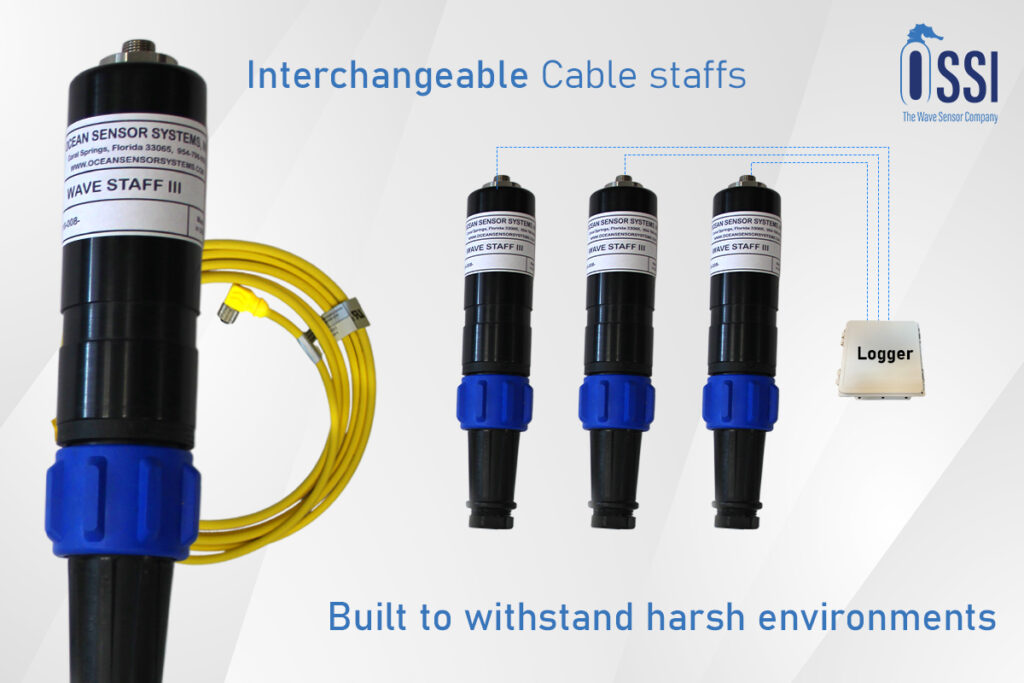
The Wave Staff III features a modular design where both the:
- Teflon-coated sensing staff
- Electrical connection cable
- can be easily replaced or modified in the field.
- This modularity offers several advantages:
- Reduced maintenance downtime
- Lower replacement costs
- Adjustable sensor lengths
- Simplified transportation
- Easier field repairs
For long-term marine projects, modular instrumentation significantly improves operational efficiency and lifecycle cost management.
Deployment Strategies for Coastal Infrastructure Projects
Coax Rod Staffs (0.5m to 2m)
Shorter rigid rod staffs are ideal for fixed mounting applications such as:
- Bridge piers
- Jetty supports
- Harbor walls
- Pier abutments
- Marine test structures
These installations provide stable, high-accuracy measurements in localized monitoring zones.
Coax Cable Staffs (Up to 11m)
Longer coax cable configurations are designed for deeper water deployments where larger tidal ranges exist.
Typical applications include:
- Offshore bridge construction
- Deep-water piers
- Floating vessel operations
- Dredging support systems
- Large tidal estuaries
The extended range ensures uninterrupted wave measurements across varying water depths.
Integration with Smart Construction Systems
Digital transformation is rapidly reshaping the construction industry. Smart infrastructure projects increasingly rely on interconnected monitoring systems and real-time data analytics.
The Wave Staff III supports both:
- 0–5V Analog Output
- RS232 Serial Communication
This compatibility allows seamless integration with:
- PLC systems
- SCADA platforms
- Data loggers
- Remote telemetry systems
- Construction management software
- IoT monitoring networks
Synchronized Multi-Sensor Monitoring
Using Sync Mode functionality, multiple Wave Staff III sensors can operate simultaneously across a bridge span or construction zone.
This enables:
- Wave front tracking
- Multi-point hydrodynamic analysis
- Structural interaction studies
- Real-time spatial monitoring
Synchronized measurements improve the quality of engineering assessments and predictive modeling.
Environmental and Temperature Monitoring
In addition to wave measurement, the Wave Staff III includes integrated air and water temperature monitoring with approximately 0.5°C accuracy.
Temperature data can support:
- Concrete curing analysis
- Worker safety planning
- Environmental compliance
- Thermal expansion studies
- Weather trend assessments
This additional environmental information enhances overall project intelligence and operational awareness.
Data Processing and Coastal Engineering Applications
The Wave Staff III outputs raw data in both ASCII and binary formats, allowing compatibility with advanced data processing software and engineering analysis tools.
Common Engineering Applications Include:
Wave Period Analysis
Used to evaluate dynamic loading effects on temporary structures and marine platforms.
Tidal Trend Monitoring
Helps distinguish long-term sea-level fluctuations from transient wave events.
Real-Time Safety Alerts
RS232-triggered alarm systems can automatically notify site operators when wave heights exceed predefined safety thresholds.
Structural Performance Monitoring
Continuous wave measurements help engineers evaluate how structures respond to changing environmental loads over time.
Benefits for Coastal Engineering Projects
Implementing the Wave Staff III provides measurable advantages for marine infrastructure projects:
- Improved worker safety
- Reduced installation complexity
- Enhanced data accuracy
- Faster deployment
- Lower maintenance costs
- Better project risk management
- Real-time operational awareness
- Long-term infrastructure reliability
These benefits contribute directly to more efficient construction workflows and reduced project delays.
Conclusion
As coastal infrastructure projects become increasingly complex, the demand for reliable and precise marine monitoring systems continues to grow. The Wave Staff III (OSSI-010-008) offers a robust, low-power, and highly accurate solution for real-time wave and water level measurement in near-shore construction environments.
Its innovative self-grounding coaxial design, high-speed sampling capabilities, modular architecture, and smart system integration make it exceptionally well suited for bridge construction, pier development, marine engineering, and coastal infrastructure monitoring.
For organizations seeking dependable wave measurement technology capable of performing in harsh marine conditions, the Wave Staff III represents a forward-looking solution that enhances safety, operational efficiency, and engineering accuracy across every phase of coastal construction.