
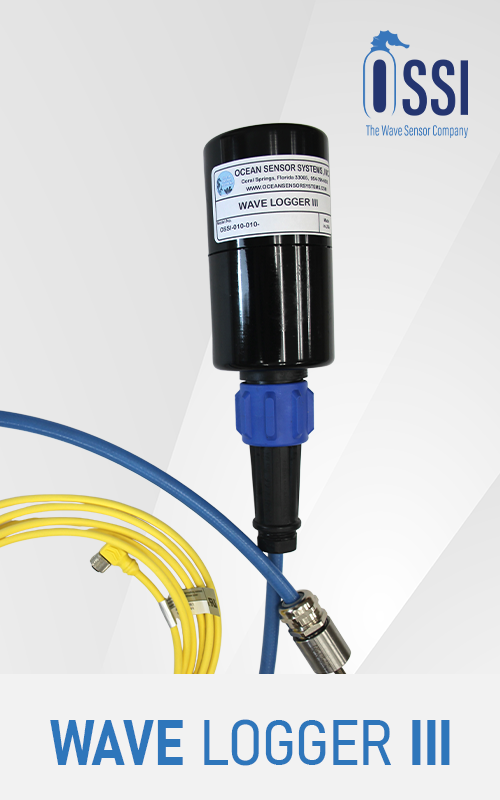
Wave Logger III (OSSI‑010‑010)
Coastal & Hydraulic Monitoring
A self-logging, self-powered wave staff system for coastal, hydraulic, and marine monitoring
Executive Summary
Coastal and hydraulic engineering projects — from breakwater assessments and harbor resonance studies to marine construction and sediment transport research — depend on accurate, high-resolution wave and water level records taken directly at the point of interest. Yet many monitoring scenarios lack access to external power supplies, telemetry infrastructure, or permanent mounting structures.
The Wave Logger III addresses this challenge with a fully self-contained platform: high-resolution wave sensing, onboard Compact Flash storage, low-power electronics, and battery-powered operation unified in a single field-ready instrument capable of months to years of unattended deployment.
The Ocean Sensor Systems Wave Logger III (OSSI-010-010) is a self-contained wave and water-level measurement system designed for long-term deployment in marine, coastal, riverine, and hydraulic environments — requiring no external power or communications infrastructure.
Unlike traditional tide gauges or pressure-based sensors, the Wave Logger III directly measures free-surface elevation through a self-grounding coaxial wave staff — enabling highly responsive wave measurements suitable for engineering studies, construction monitoring, laboratory research, and operational decision-making. The system is specifically designed for deployments where reliability, ease of installation, and long-term unattended operation are critical.
Product overview
The Wave Logger III integrates four primary subsystems into a single field-ready instrument, eliminating the need for any external infrastructure. The instrument stores water-level measurements on a Compact Flash card in either ASCII or binary format with embedded date and time information, retrievable with any standard CF card reader and PC.
Wave Staff Measurement Circuit
Teflon-insulated coaxial sensing cable converts immersion depth to digital counts (0–4095) with ±0.25% accuracy over the central measurement range.
Compact Flash Data Logger
Onboard CF storage up to 2 GB in standard FAT16 format — up to 936 million binary samples or 388 million ASCII samples across a maximum of 512 files.
Waterproof Housing
Rugged sealed enclosure rated to 30 m water depth with cable tension tolerance up to 500 N — built for exposed marine and coastal deployments.
Battery Power System
Four C-cell alkaline batteries delivering months of continuous operation or years of burst-mode recording — no shore power or charging infrastructure required.
Self-grounding coaxial staff: A defining design feature that eliminates the need for a separate grounding electrode in the water — significantly simplifying installation and improving deployment flexibility compared to non-coaxial wave staff designs.
Technical specifications
The Wave Logger III's electronics combine a low-power microprocessor with a temperature-stable sensing circuit. Temperature stability provides repeatable measurements better than 0.1%, supporting long-term campaigns where sensor drift would otherwise compromise multi-month records.
Storage capacity by Compact Flash format (2 GB card, max 512 files):
| Format | Max samples | Typical use case |
|---|---|---|
| Binary | 936 million | Long-term continuous or burst recording |
| ASCII | 388 million | Direct import to MATLAB, Python, Excel |
Supported CF card sizes: 64 MB · 128 MB · 256 MB · 512 MB · up to 2 GB. Serial programming via RS232 at 9600 baud. Optional air temperature logging embedded in serial output records.
Converting raw counts to physical water level:
// referenced to datum → Hs, Hmax, wave period, spectral energy, run-up
Sensor configurations
The Wave Logger III is available with interchangeable Teflon-insulated coaxial cable staffs across a wide range of lengths — from compact laboratory flume sizes to large tidal-range coastal deployments. Staff selection is made based on site depth, tidal range, and expected wave height.
- ✓Interchangeable staffs: Only the sensing cable needs replacement when measurement range changes or damage occurs — the electronics housing and logger are reused, minimising lifecycle cost.
- ✓Self-grounding design: The coaxial construction eliminates a separate water grounding electrode, simplifying installation at piers, piles, temporary frames, and laboratory test rigs alike.
- ✓Cable tension rating: 0–500 N cable tension tolerance maintains measurement integrity under moderate current, wave loading, or installation stress.
- ✓Optional air temperature logging: Simultaneous air temperature records embedded alongside wave data for comprehensive environmental documentation.
- ✓Programmable sampling modes: Selectable rates of 2, 5, 10, 20, or 30 Hz in continuous or burst recording modes — matched to power budget and analysis requirements.
Data acquisition & processing workflow
From measurement to analysis, the Wave Logger III follows a clear five-step process requiring no specialist infrastructure beyond a standard CF card reader and a PC running any common engineering or scientific analysis environment.
Water level measurement
The coaxial wave staff continuously measures immersion depth and converts it into digital values from 0000 to 4095 counts at the configured sample rate (2–30 Hz).
Time stamping
The internal real-time clock attaches year, month, day, hour, minute, and second to each measurement burst — providing a fully dated, self-contained record with no external time reference needed.
Data storage
Measurements are stored in ASCII or binary format with configuration metadata embedded in file headers. New files are created at user-defined intervals from 1 to 255 days; up to 512 files per card.
Data retrieval
Users remove the Compact Flash card and import files into MATLAB, Python, Excel, or specialist oceanographic and coastal engineering platforms via any standard CF card reader.
Wave analysis
Collected records yield significant wave height (Hs), maximum wave height, wave period, spectral energy distribution, wave run-up, harbor oscillation characteristics, and water level trends.
Deployment strategies
The self-contained architecture and battery power system of the Wave Logger III support a wide range of mounting and deployment scenarios — all without any external infrastructure requirements. The coaxial wave staff extends vertically into the water column while the logger enclosure is mounted above or near the structure.
Fixed structure installation
Mount on pier piles, seawalls, quay walls, bridge supports, or offshore platforms. Logger enclosure stays above splash zone; staff extends vertically into the water column.
Temporary construction monitoring
Attach to temporary frames, survey poles, construction barges, or access structures for rapid campaign-style deployment and removal during marine construction projects.
Hydraulic laboratory
Rod staffs on fixed test frames in wave flumes and physical hydraulic models — supporting wave transformation, overtopping, sediment transport, and numerical model validation studies at up to 30 Hz.
Remote environmental monitoring
Low-power architecture enables months of continuous — or years of burst — operation at remote islands, coastal research stations, estuaries, and river monitoring sites without servicing.
For debris-prone or high-impact locations, protective mounting structures are recommended. Periodic inspection should cover biofouling removal from the sensing cable, cable integrity checks, battery condition, and available storage space confirmation.
Engineering applications
The Wave Logger III's direct surface-elevation measurement, autonomous operation, and flexible staff lengths make it applicable across a broad spectrum of coastal, marine, and hydraulic engineering contexts.
Nearshore wave conditions, water level fluctuations, beach response, coastal erosion assessments, and wave run-up and overtopping monitoring at temporary or permanent coastal structures.
Direct surface elevation measurements immediately adjacent to structures to evaluate wave transmission, reflection coefficients, overtopping risk, and structural performance.
Vessel wake monitoring, harbor resonance studies, berthing condition assessment, and dock safety analysis — deployable independently without permanent infrastructure at any location.
Wave condition monitoring during cofferdam construction, dredging, jetty construction, bridge foundation installation, and offshore access works — where wave conditions directly affect safety and workability.
Wave flumes, physical hydraulic models, sediment transport experiments, overtopping tests, and numerical model validation — leveraging the sensor's high-frequency capability at up to 30 Hz.
Key benefits
Fully autonomous operation
Four C-cell batteries with onboard CF storage deliver months of continuous or years of burst-mode operation — no external power, cabling, or telemetry required.
High temporal resolution
Programmable rates from 2 to 30 Hz — resolving short-period wind waves, boat wakes, and rapid transients in continuous or burst sampling modes.
Proven measurement quality
±0.25% accuracy over the central range, 0.025% resolution, 0.25% linearity, and better-than-0.1% temperature stability for reliable long-term records.
Simplified installation
Self-grounding coaxial staff design eliminates a separate water grounding electrode — reducing setup complexity and enabling rapid deployment across diverse site configurations.
Large onboard storage
Up to 2 GB Compact Flash in standard FAT16 format — 936 million binary or 388 million ASCII samples across up to 512 files, compatible with any standard CF card reader.
Low lifecycle cost
Staff-only replacement when lengths change or damage occurs — the sealed electronics module and logger housing are retained and reused across multiple deployments.
Limitations & considerations
Prospective users should account for the following operational considerations when evaluating the Wave Logger III for their application:
- !Physical exposure: The wave staff is directly exposed to the environment. Installations in debris-prone or high-impact locations should incorporate protective mounting structures to prevent damage to the sensing cable.
- !No native telemetry: The standard configuration relies entirely on onboard CF storage and provides no real-time wireless communications. Users requiring live monitoring should evaluate complementary telemetry options — such as integration with the OSSI-012-015 Data Logger — to add RF or Bluetooth transmission capability.
- !Manual data retrieval: Without a telemetry modem, the Compact Flash card must be physically retrieved from the site to access recorded data — an important consideration for very remote or difficult-access deployments.
- !Regular maintenance recommended: Although engineered for long deployments, periodic inspection is advised to remove biofouling from the sensing cable, verify cable integrity, check battery condition, and confirm available storage capacity remains sufficient.
Conclusion
The Ocean Sensor Systems Wave Logger III (OSSI-010-010) is a robust, self-powered wave measurement solution engineered for reliable long-term operation in challenging marine and hydraulic environments. Its combination of high-resolution wave sensing, low-power electronics, flexible deployment options, onboard Compact Flash data storage, and extended battery-powered operational life provides an effective platform for collecting high-quality water-level and wave data wherever external power and communications infrastructure cannot be relied upon. The self-grounding coaxial staff design, interchangeable staff lengths from 0.5 m to 11 m, configurable sampling rates up to 30 Hz, continuous and burst recording modes, and standard FAT16 data format make the Wave Logger III the preferred choice for coastal engineering consultants, port authorities, research institutions, marine contractors, and government agencies requiring autonomous, long-duration wave measurements across coastal, harbor, hydraulic laboratory, marine construction, and environmental monitoring applications.