
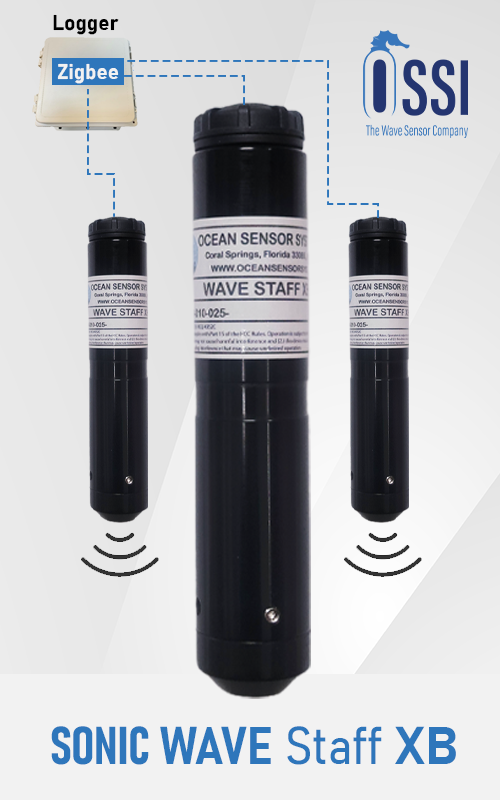
Sonic Wave Sensor XB (OSSI‑010‑035)
Wireless Ultrasonic Wave Measurement
A non-contact ultrasonic wave and water-level measurement system with ZigBee/XBee wireless networking for coastal engineering, laboratory, and hydrological monitoring applications
Executive Summary
Wave and water-level monitoring traditionally relies on submerged probes, pressure transducers, capacitance wave staffs, or float-based systems — all of which can suffer from corrosion, biofouling, installation complexity, and ongoing maintenance challenges. The Sonic Wave Sensor XB takes a fundamentally different approach: non-contact ultrasonic sensing combined with wireless ZigBee networking.
The Ocean Sensor Systems Sonic Wave Sensor XB (OSSI-010-035) is a wireless ultrasonic wave and water-level measurement system combining ultrasonic sensing, ZigBee/XBee networking, synchronized sampling, anti-aliasing signal processing, and low-power embedded electronics inside a rugged IP67-rated enclosure.
The system supports synchronized sampling of up to eight wireless devices on a ZigBee Personal Area Network (PAN), configurable sampling rates up to 32 Hz, submillimeter wave measurement capability, and multiple digital output formats including ASCII, binary float, and binary integer data streams. The Sonic Wave Sensor XB integrates with Ocean Sensor Systems' Staff & Sonic Interface Program for configuration, visualization, spectral analysis, calibration, and data logging.
Product overview
The Sonic Wave Sensor XB is a wireless ultrasonic wave sensor that measures the distance between the sensor head and the water surface using acoustic pulse reflection. The sensor transmits ultrasonic pulses downward toward the liquid surface and measures the echo return time to determine water level or wave height. The device is battery-powered using two standard C-size cells and optimized for long-term autonomous operation in remote environments.
Ultrasonic transducer
Emits and receives ultrasonic pulses, providing the foundation for non-contact distance measurement to the water surface below the sensor.
Low-power microprocessor
Embedded controller performs pulse timing, signal processing, and anti-aliasing filtering at 64 Hz internal sampling.
XBee RF module
ZigBee 2.4 GHz wireless module enables PAN networking and synchronized communication with up to 8 sensors per network.
RTC & IP67 enclosure
Real-time clock with battery monitoring electronics, all sealed inside an IP67-rated enclosure for harsh outdoor and marine environments.
Core features documented by the manufacturer include ZigBee/XBee wireless connectivity, synchronized sampling, support for up to 8 sensors per PAN, sampling rates of 1–32 Hz, continuous or burst sampling modes, time-tagged data, real-time clock synchronization, automatic anti-aliasing filtering, battery voltage monitoring, multiple output data formats, IP67 environmental protection, optional high-accuracy calibration, long battery life, and submillimeter wave measurement capability.
Ultrasonic measurement principle
The Sonic Wave Sensor XB operates using ultrasonic time-of-flight measurement principles. The sensor continuously emits ultrasonic pulses downward toward the water surface, and the reflected echo is received by the transducer. The embedded processor calculates the distance based on the round-trip travel time:
// L = distance from sensor to water surface
// T = ultrasonic pulse round-trip travel time
// C = speed of sound in air (½ factor compensates for round-trip path)
Why non-contact matters: Unlike capacitance wave staffs that require direct contact with the water, the Sonic Wave Sensor XB is mounted above the water surface. This design fundamentally changes the maintenance profile of a deployment — no submerged components means no biofouling on the sensing element and no electrochemical corrosion of contact surfaces.
- ✓No direct water contact — the sensor never touches the liquid being measured.
- ✓Reduced corrosion risk — particularly valuable in saltwater and aggressive industrial environments.
- ✓Minimal biofouling — no submerged surface for marine growth to accumulate on.
- ✓Simplified installation — mount above the water with no need for waterline penetrations.
- ✓Reduced maintenance — significantly fewer service trips needed over a long deployment.
- ✓Suitable for contaminated or saline environments — wastewater, brine, and industrial process liquids.
Technical specifications
The Sonic Wave Sensor XB delivers submillimeter wave measurement resolution alongside flexible sampling rates, multiple output formats, and ZigBee wireless networking — all within an IP67-rated enclosure suitable for outdoor and marine deployment.
Configurable sampling rates:
Measurement range zones
The datasheet divides sensor performance into five operational zones (A–E), classified by wave steepness tolerance and sensor-to-water distance. Selecting the correct zone for your application is critical to achieving the expected accuracy and data integrity.
Shortest distance
Highest wave-steepness tolerance — ideal for fast submillimeter wave measurements.
Moderate distance
Suitable for boat wakes and intracoastal wave monitoring.
Mid-range
Optimised for laboratory wave tank deployments.
Longer distance
Lower wave steepness tolerance, longer sensor-to-water distance.
Tides primarily
Lowest wave-steepness capability — primarily for tide measurement applications.
During extremely steep wave conditions the sensor may lose samples; in these cases the system reports the last valid sample until a new valid measurement is obtained — preserving data continuity for the host system.
Wireless communication architecture
The Sonic Wave Sensor XB uses Digi XBee or XBee-PRO ZigBee radio modules operating at 2.4 GHz. The system supports synchronized operation of up to eight sensors within a single Personal Area Network — enabling multi-sensor directional and spatial wave studies without per-sensor cabling.
- ✓ZigBee PAN networking — coordinated multi-sensor wireless mesh.
- ✓Wireless synchronization — time-aligned sampling across the entire array.
- ✓Real-time timestamping — every sample tagged via on-board RTC.
- ✓Multi-sensor networking — up to 8 devices per PAN, dynamically managed.
- ✓USB and RS232 gateway interfaces — integration with PCs, loggers, and PLCs.
Line-of-sight wireless range depends on the adapter configuration in use:
| Configuration | Line-of-sight range | Notes |
|---|---|---|
| Standard XB | 1.2 km | Suitable for most laboratory and dockside deployments |
| XB-PRO | 3.2 km | Extended range for harbor-wide or coastal array deployments |
Indoor or urban environments reduce operational range significantly due to signal attenuation. Available gateway adapters include the XStick USB adapter, waterproof XBee-to-USB adapter, and XBee RS232 adapter — enabling integration with PCs, laptops, data loggers, PLC systems, and SCADA infrastructure.
Data formats & signal processing
The sensor supports four data transmission modes — letting users trade off bandwidth, resolution, and integration simplicity to match the host system.
ASCII single sample
Low-bandwidth text output — easiest to integrate with terminal programs, loggers, and ad-hoc serial host scripts.
ASCII 32-sample buffer
Buffered text blocks — reduces wireless transmission overhead while preserving human readability.
Float 32-sample buffer
Binary floating-point format delivering full 0.1 mm resolution — the recommended mode for high-resolution wave analysis.
Integer 64-sample buffer
Compact integer representation — maximises data throughput across the ZigBee link for long-duration array deployments.
Anti-aliasing filter: The automatic anti-aliasing filter operates at 64 Hz internal sampling and averages readings according to the configured output rate. The manufacturer recommends setting the sample rate to 8× the maximum wave frequency to minimize aliasing artifacts and improve signal quality.
The integrated real-time clock supports time-tagged measurements with automatic synchronization, ~10 PPM typical accuracy, and PC clock synchronization — enabling synchronized multi-sensor arrays for directional wave studies, spatial analysis, and long-duration unattended monitoring campaigns.
Power system & software ecosystem
Battery life is governed by sampling rate, wireless transmission mode, burst duty cycle, and filter enable status. Operational durations range from approximately 12 days at high continuous rates up to more than 200 days using low-duty-cycle burst modes.
The included Staff & Sonic Interface Program provides a complete PC-based ecosystem for sensor management and data analysis — eliminating the need for separate configuration, visualization, and processing tools.
- ✓Device configuration — set sample rate, format, filter, and network parameters.
- ✓Real-time plotting — visualize live wave traces from one or many sensors.
- ✓Spectral analysis — built-in FFT for wave frequency analysis, significant wave height, mean water level, and windowing operations.
- ✓Data logging — record live streams to disk for post-processing.
- ✓Calibration tools — up to 12-point in-situ calibration for nonstandard mounting heights or environmental compensation.
- ✓Multi-sensor monitoring — observe and manage an entire PAN array from one interface.
Applications & deployment
The Sonic Wave Sensor XB is well-matched to coastal engineering, hydraulic laboratory, marine monitoring, and industrial liquid-level applications — particularly where non-contact measurement, wireless deployment, and synchronized arrays offer clear advantages.
Laboratory wave tanks
Wave flumes, physical hydraulic models, harbor simulations, and breakwater studies — leveraging submillimeter resolution, wireless deployment, high temporal resolution, and easy repositioning.
Harbor & marina monitoring
Boat wake monitoring, harbor resonance studies, wave energy measurements, and mooring condition assessment — wireless operation reduces infrastructure complexity in marine environments.
Tide & water-level monitoring
Tidal monitoring, canal levels, reservoirs, ponds, and pools — non-contact design reduces maintenance in saline or contaminated water.
Multi-sensor directional arrays
Synchronized sampling supports directional wave analysis using arrays — wave propagation, coastal structure interaction, sediment transport, and offshore hydrodynamics studies.
Successful deployment depends on three planning areas — installation, network, and calibration:
Mount vertically above water, avoid reflective obstructions, minimize beam interference, ensure rigid mounting structures, and maintain proper distance from walls and reflective surfaces.
Maintain line-of-sight where possible, elevate gateways above obstructions, minimize Wi-Fi interference at 2.4 GHz, and use XBee-PRO modules for extended-range coastal deployments.
Factory calibration is included, but in-situ calibration may improve accuracy. The system supports up to 12-point calibration for laboratory precision studies, nonstandard mounting heights, or environmental compensation.
Benefits, limitations & conclusion
Non-contact measurement
Reduces corrosion and fouling significantly — the sensing element never touches the liquid being measured.
Wireless synchronization
Simplifies multi-sensor deployments with no inter-sensor cabling and PAN-wide time alignment across up to 8 sensors.
High resolution
Supports submillimeter wave measurements at 0.1 mm resolution in binary float mode — ideal for laboratory precision studies.
Flexible sampling
Six configurable rates from 1 to 32 Hz, continuous or burst — match the sampling strategy to wave frequency and battery budget.
Rugged construction
IP67 environmental protection makes the sensor suitable for outdoor, marine, harbor, and harsh industrial deployments.
Long battery life
~12 days continuous, 200+ days in burst mode — with an optional lithium pack extending life by approximately 2.4×.
Integrated spectral analysis
Built-in software performs wave frequency analysis, significant wave height, mean water level, and windowing — reducing post-processing effort.
Automatic anti-aliasing
64 Hz internal filtering with rate-matched averaging delivers clean, low-noise wave records straight from the sensor.
Operational considerations:
- !Environmental sensitivity: Ultrasonic sensors can be affected by temperature changes, wind turbulence, spray and condensation, heavy rain, and extreme humidity — installation should consider these factors.
- !Range constraints: The 2.5 m maximum range may be insufficient for deep reservoirs, large tanks, or high-tide offshore installations where the sensor sits far above the water surface.
- !Wave steepness constraints: Extremely steep or breaking waves may temporarily reduce data quality — the sensor reports the last valid sample until acquisition recovers.
Pre-purchase checklist: Evaluate required measurement range, maximum expected wave steepness, deployment duration, wireless range requirements, number of synchronized sensors needed, environmental exposure conditions, and required data resolution before specifying a configuration.
The Sonic Wave Sensor XB (OSSI-010-035) represents a specialized ultrasonic wave and water-level measurement platform optimized for scientific, coastal, and laboratory applications. Its combination of wireless ZigBee networking, synchronized multi-sensor operation, high-resolution ultrasonic sensing, configurable data formats, and integrated spectral analysis capabilities distinguishes it from conventional industrial ultrasonic level sensors. The system is particularly valuable for coastal engineering, wave tank research, tide monitoring, and distributed hydrodynamic sensing applications where non-contact measurement, wireless deployment, and synchronized sampling are critical. Although environmental conditions and wave steepness limitations must be considered during deployment planning, the Sonic Wave Sensor XB provides a robust and technically advanced solution for modern wave and water-level monitoring requirements.