
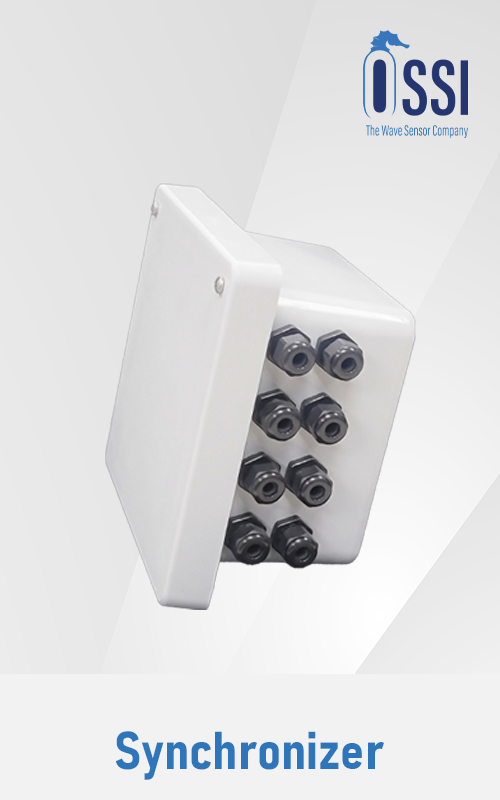
Wave Staff Synchronizer (OSSI‑012‑012C)
Multi-Sensor Coordination & Control
A multi-channel synchronization and control unit for coordinated operation of resistive Wave Staff sensors across oceanographic, coastal, and hydraulic monitoring applications
Introduction
Wave array studies, directional wave analysis, vessel hydrodynamics experiments, and coastal monitoring programs all depend on accurate phase relationships between multiple wave measurements. Without precise synchronization across sensors, spatial wave information becomes unreliable — and the analyses built on top of it (reflection coefficients, directionality, propagation velocity, coherence) lose their meaning.
The OSSI-012-012C addresses this challenge through a centralized synchronization architecture that coordinates simultaneous sampling, power distribution, and serial data aggregation across a multi-staff array.
The Ocean Sensor Systems Wave Staff Synchronizer (OSSI-012-012C) is a specialized multi-channel synchronization and control unit developed for coordinated operation of resistive Wave Staff sensors — enabling synchronized sampling, centralized control, and aggregated data acquisition from multiple wave staffs.
The synchronizer is particularly valuable in oceanographic, coastal engineering, hydraulic laboratory, and offshore monitoring applications where phase-coherent wave measurements across multiple locations are essential.
Product overview
The OSSI-012-012C acts as a centralized synchronization hub managing up to six Wave Staff sensors per unit. Multiple synchronizers can be daisy-chained together to support larger measurement arrays of 12 to 18 synchronized sensors — addressing the needs of both compact laboratory experiments and large-scale coastal observation networks.
Automatic sensor detection
The synchronizer polls all six sensor ports on startup, detects connected Wave Staffs, and assigns active channel addresses without manual configuration.
Synchronous sampling coordination
All connected sensors sample on the same time base — preserving the precise phase relationships required for directional and spatial wave analysis.
Centralized power distribution
A single power input feeds all six channels with up to 4 A fused output — eliminating per-sensor power cabling and simplifying field deployments.
RS-232 data aggregation
Consolidates all sensor outputs into a single serial data stream with real-time clock management and optional time-tagged records — one logger connection serves the entire array.
Built-in expansion capability via daisy-chaining means the same hardware platform scales from a 6-staff laboratory rig to an 18-staff coastal monitoring array without architectural changes.
System architecture
The OSSI-012-012C provides eight connectors in total — six dedicated sensor ports plus two for host communication, daisy-chain expansion, and inter-unit synchronization.
| Connector | Role | Capabilities |
|---|---|---|
| J1 – J6 | Sensor ports | Power, bidirectional serial, sample timing per channel |
| J7 | Host / chain | Host RS-232 communication and daisy-chain expansion |
| J8 | Sync / chain | Inter-unit synchronization for multi-synchronizer arrays |
- ✓Each of the six sensor ports (J1–J6) independently provides regulated power to its connected Wave Staff.
- ✓Each port maintains a bidirectional serial communication link to its sensor for configuration and data return.
- ✓Each port participates in the synchronized sample timing coordinated by the central controller.
- ✓Connectors J7 and J8 enable daisy-chain expansion to scale beyond a single synchronizer.
Synchronization mechanism & sampling modes
On power-up the synchronizer executes a startup routine that brings every connected sensor into a known, time-aligned state within approximately six seconds.
Poll all six sensor ports
Each of J1–J6 is checked for the presence of an attached Wave Staff sensor.
Detect connected Wave Staffs
Active sensors are identified and confirmed responsive on the serial channel.
Assign active channel addresses
Each detected sensor receives its working address for the upcoming acquisition session.
Configure operational parameters
Sampling frequency, mode, and time-tag settings are propagated to every active channel.
Align sample timing
All active sensors are brought onto a common sample clock — the prerequisite for phase-coherent measurements.
The OSSI-012-012C then supports two operational sampling modes selected by the user:
Free-run mode
All connected Wave Staffs sample continuously at a predefined frequency — selectable from 2, 5, 10, 20, or 30 Hz. Suited to continuous environmental monitoring, long-duration coastal observations, and general wave climate studies.
Command mode
Sampling occurs only when externally triggered. Suited to wave tank experiments, towing tank synchronization, motion-control testing, and tightly controlled laboratory studies where acquisition must align with other experimental events.
Data acquisition & communications
The synchronizer aggregates measurements from all active channels into fixed-format CSV-style serial records. Each output frame always contains six channel fields regardless of how many sensors are physically connected — empty fields hold placeholder values.
- ✓Simplified parsing — fixed field count means simple, reliable record decoding in any host software.
- ✓Consistent logger configuration — the same data logger setup works regardless of array population.
- ✓Easier software integration — predictable structure reduces parser maintenance across project versions.
- ✓Predictable data structure — supports post-processing pipelines and downstream tools.
9.6 kbaud bidirectional serial
Each J1–J6 port maintains a 9.6 kbaud bidirectional serial link to its attached Wave Staff sensor — used for configuration and per-channel data return.
38.4 kbaud RS-232, 8N1, no flow control
The aggregated multi-channel data stream is delivered to the host data logger or PC via RS-232 at 38.4 kbaud, 8N1, no flow control — a single connection for the entire array.
Technical specifications
The OSSI-012-012C combines low-power consumption with rugged environmental protection — supporting harsh marine deployments while remaining compatible with battery and solar-powered installations.
The rugged NEMA 4X / IP66 enclosure supports deployment in harsh marine and coastal environments including wave flumes, offshore platforms, coastal stations, piers, and breakwaters.
Configuration & software interface
The OSSI-012-012C is configured through serial terminal commands — a compact, scriptable interface that allows rapid setup, repeatable deployments, and easy cloning across multiple units in larger arrays.
| Command | Function |
|---|---|
| st | Enter setup mode |
| m | Select run mode (free-run / command) |
| f | Set sampling frequency |
| r | Read real-time clock |
| s | Set real-time clock |
| t | Configure time tags |
| g | Start acquisition |
The integrated real-time clock supports optional time stamps at three intervals — selectable depending on deployment duration and downstream synchronization needs:
- ✓Long-term synchronization across multi-day campaigns.
- ✓Event correlation with external systems sharing the same wall-clock reference.
- ✓Multi-system integration with cameras, motion platforms, or data loggers using independent clocks.
- ✓Post-processing accuracy when correlating large records back to absolute time.
Engineering applications
The synchronizer is applicable wherever multiple Wave Staff sensors must produce phase-coherent records of a shared wave field — from controlled laboratory experiments to large outdoor monitoring arrays.
Coastal engineering
Nearshore wave studies, beach erosion monitoring, wave run-up analysis, coastal structure testing, and breakwater performance evaluation — calculating wave propagation, reflection coefficients, directionality, and energy dissipation from synchronized arrays.
Hydraulic laboratories
Wave tank and flume experiments — scale-model testing, wave transformation studies, sediment transport analysis, and wave-structure interaction experiments where multi-staff synchronization is essential.
Vessel hydrodynamics
Sinkage measurements, trim analysis, wake studies, shallow-water squat analysis, and maneuvering basin experiments — where synchronous acquisition preserves the phase relationships between measurement locations.
Marine renewable energy
Wave energy converters, floating offshore wind systems, breakwaters, and hybrid marine structures — large synchronized arrays provide detailed spatial wave characterization around test devices.
Why synchronization matters: Synchronized arrays enable calculations that single-point sensors cannot deliver — wave propagation velocity, reflection coefficients between incident and reflected components, full wave directionality, and energy dissipation across a structure. None of these are recoverable from independently-clocked sensors.
Deployment considerations
Successful field deployment of the OSSI-012-012C and its sensor array depends on careful planning across three areas: power, cabling, and data management.
Account for synchronizer power draw (~21 mA @ 12 V), combined sensor current across all active channels, logger power requirements, and the expected environmental operating duration to size batteries or solar panels correctly.
Use shielded communication cables, install waterproof junctions, manage strain relief on all connectors, and ensure proper grounding — particularly important in long cable runs and exposed marine deployments.
Maintain explicit channel mapping documentation, sensor calibration records, sampling configurations, and full deployment metadata — especially critical for 12+ sensor arrays where field-level traceability becomes a project risk.
Benefits, limitations & conclusion
The OSSI-012-012C delivers clear advantages for synchronized wave measurement campaigns, alongside a small set of considerations buyers should weigh against their integration environment.
High synchronization accuracy
Ensures phase-coherent measurements across all six channels — the foundation for reliable directional and propagation analysis.
Scalable architecture
Daisy-chain expansion supports 6 to 18 synchronized sensors from the same hardware platform — laboratory through coastal array.
Simplified integration
A single aggregated RS-232 output minimizes logger complexity — one cable carries the entire array's data stream.
Rugged field design
NEMA 4X / IP66 enclosure withstands demanding marine deployments at coastal stations, offshore platforms, and pier-mounted installations.
Low power consumption
~16–21 mA quiescent draw makes the synchronizer well-suited to solar-powered stations, remote monitoring systems, and battery-operated deployments.
Time-tagged records
Built-in RTC with optional minute/hour/daily time tags supports long-term synchronization and event correlation with external systems.
Operational considerations:
- !Serial communication constraints: The system relies on RS-232 — modern USB or Ethernet-based systems may require converters or adapters for integration.
- !Limited native sampling frequencies: Sampling rates are restricted to predefined discrete frequencies (2, 5, 10, 20, 30 Hz) rather than freely programmable values.
- !Dependence on compatible sensors: The synchronizer is designed specifically for Ocean Sensor Systems Wave Staff products — third-party sensors are not supported.
The OSSI-012-012C Wave Staff Synchronizer is a robust and scalable synchronization platform for multi-sensor wave measurement systems. Its synchronized acquisition capabilities, rugged NEMA 4X / IP66 enclosure, low power requirements, and expandable daisy-chain architecture make it suitable for laboratory research, coastal monitoring, offshore studies, and marine engineering applications. By centralizing timing, power distribution, and serial communications, the system simplifies deployment while improving data integrity and synchronization accuracy across large Wave Staff arrays. For coastal engineers, oceanographic researchers, and hydrodynamic laboratories requiring reliable synchronized wave measurements, the OSSI-012-012C provides an efficient and technically mature solution.