
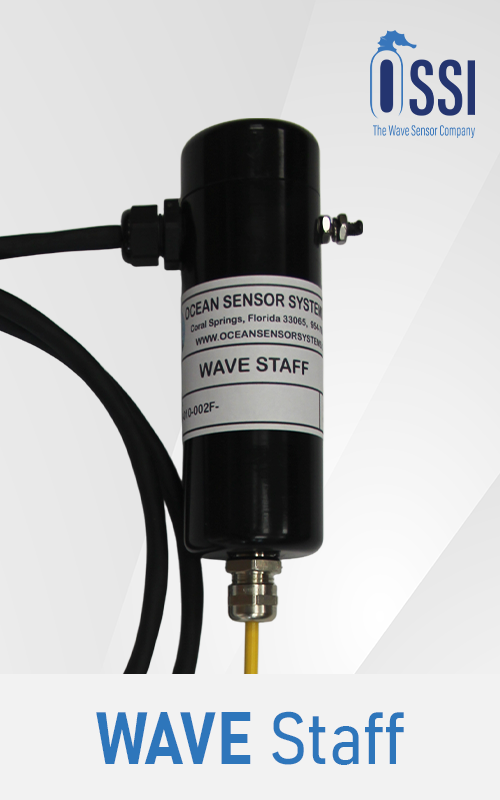
Wave Staff (OSSI‑010‑002F)
High-Resolution Water Level & Wave Measurement
Cutting through the waves — a high-resolution wave staff for coastal monitoring, laboratory hydrodynamics, offshore testing, and industrial liquid-level applications
Executive Summary
Accurate water level and wave monitoring is essential across coastal infrastructure design, offshore platform analysis, harbor operations, sediment transport studies, laboratory wave tank testing, and flood monitoring — all of which depend on the reliable measurement of changing water surfaces with high temporal fidelity.
The OSSI-010-002F is engineered for these challenges, combining a rugged waterproof architecture with interchangeable Teflon-coated staffs up to 20 meters, high sampling speed, low power consumption, programmable outputs, and flexible integration capabilities into a single compact sensing platform.
The Ocean Sensor Systems Wave Staff (OSSI-010-002F) is a high-resolution water level and wave measurement sensor supporting analog 0–5 V output, RS232 serial communication, synchronized sampling, programmable alarms, and configurable acquisition frequencies up to approximately 110 Hz.
This combination makes the OSSI-010-002F particularly suitable for environments where precise surface elevation measurements and dynamic wave capture are required — across coastal monitoring, laboratory hydrodynamics, offshore testing, inland water management, and industrial liquid-level applications.
Product overview
The OSSI-010-002F is a contact-based water level sensor that brings together rugged marine construction with modern digital electronics. The system operates from 5.5 V to 40 V DC and supports flexible deployment in standalone, integrated SCADA, laboratory DAQ, or synchronized multi-sensor wave array configurations.
Waterproof electronics enclosure
Rugged marine-grade housing protects the temperature-stable sensing circuit and low-power microprocessor across harsh deployment environments.
Interchangeable Teflon-coated staffs
One electronics package supports multiple deployment environments through interchangeable rod or cable staffs from 1 m up to 20 m.
Multiple data interfaces
Analog 0–5 V output, RS232 serial output, and dual programmable alarm outputs — all available simultaneously from a single sealed unit.
Flexible sampling modes
Free-run continuous sampling for autonomous monitoring or sample-on-command mode for synchronized multi-sensor wave array deployments.
Optional integrated air and water temperature monitoring is available alongside the primary water-level output for comprehensive environmental documentation.
Measurement principle
The OSSI-010-002F uses a conductive sensing principle: the immersed length of the Teflon-coated staff changes the electrical characteristics of the sensing circuit as the water surface rises and falls. The electronics convert these changes into digital counts (0–4095), analog voltage levels, and RS232 serial data strings — all available concurrently.
Why direct contact measurement: Among traditional wave-monitoring options — pressure transducers, radar level sensors, ultrasonic sensors, buoys, and capacitive/resistive wave staffs — wave staffs remain the most effective solution for direct surface elevation measurement in high-frequency, short-period wave environments.
- ✓High temporal resolution — wave staffs capture fast wave oscillations with minimal latency.
- ✓Excellent short-period wave response — the sensor directly tracks the water surface rather than inferring elevation from pressure or acoustic reflection.
- ✓Reduced signal interpretation complexity — unlike radar or ultrasonic systems, wave staffs do not require echo analysis or beam compensation.
- ✓Strong laboratory performance — widely used in wave flumes and hydrodynamic research due to precise surface tracking capability.
The OSSI-010-002F extends this traditional approach with modern digital electronics, programmable control logic, synchronized acquisition capability, and flexible analog/serial integration.
Technical specifications
The OSSI-010-002F combines a low-power microprocessor with a temperature-stable sensing circuit, delivering high measurement quality across a wide dynamic range.
Sampling capabilities across operating modes:
| Mode | Frequency | Notes |
|---|---|---|
| Analog output sampling | Up to 110 Hz | Highest temporal resolution, ideal for wave/wake transients |
| RS232 free run | 2–30 Hz | Standalone continuous serial telemetry |
| Sync sampling | Up to ~33 Hz | Multi-sensor array coordination |
| TTL sync pulse | 10 µs | Sample-on-command triggering for arrays |
Serial output range is 0–4095 counts. Optional integrated temperature reporting provides 0.0625 °C resolution alongside the water-level measurement.
Mechanical design & staff configurations
The OSSI-010-002F supports interchangeable staffs from 1 meter to 20 meters in two main construction types — letting one electronics package serve very different deployment environments.
Teflon-coated rods
Typically used for shorter measurement ranges and laboratory applications — including specialized 0.25 m and 0.5 m rods, and 1–5 m rod staffs for harbor structures and test frames.
Teflon-coated cables
Designed for deeper deployments and field installations — including 5.5–20 m cable staffs for offshore pier approaches, deep estuaries, and large wave basins.
Typical staff length options available from the datasheet:
This modular approach minimizes lifecycle cost — when measurement geometry changes or damage occurs, only the staff is replaced, not the electronics.
Data outputs & alarm control
The Wave Staff integrates four output channels in a single sealed unit, allowing it to function simultaneously as a high-resolution sensor, alarm trigger, serial telemetry source, and analog signal generator.
0–5 V output
Direct integration with data acquisition systems, PLCs, industrial controllers, oscilloscopes, and laboratory DAQ — ideal for high-speed wave analysis, spectral processing, and real-time control.
RS232 — 9600 baud
ASCII or binary output transmitting water level, air temperature, and water temperature. Example: 2345 +052 +048
Open-drain trip output
Programmable high or low trigger with separate trip and reset thresholds. 350 mA capability with inductive load clamping — drives relays, pumps, beacons, gates, or SCADA inputs.
Independent open-drain output
Second independent threshold channel — enables dual-level control such as pump start/stop, multi-stage warning systems, or staged automated responses.
Serial outputs integrate with PCs, embedded controllers, industrial gateways, remote telemetry systems, and SCADA platforms. The dual alarm architecture means the Wave Staff functions not only as a monitoring device but also as an active process control sensor.
Synchronized sampling & multi-sensor arrays
One of the most valuable capabilities of the OSSI-010-002F is its synchronized acquisition support — enabling spatially distributed wave staffs to produce time-aligned records of a propagating wave field.
- ✓TTL sync triggering — external 10 µs pulse coordinates simultaneous sampling across an array.
- ✓Serial command synchronization — issue sample commands programmatically from a host controller.
- ✓Sample-on-command acquisition — sensors hold ready, then capture in unison on request.
Synchronized arrays enable advanced analysis that single-point sensors cannot deliver:
Quantify how wave components relate across space — essential for wave basin experiments, multi-point wave field measurements, and coastal array monitoring.
Construct spatial wave profiles with precise temporal alignment — supporting reflection, diffraction, and directional wave calculations from staff arrays.
Configuration & communications
The OSSI-010-002F is configured over RS232 with a compact set of commands and a structured ASCII configuration string — enabling rapid field reconfiguration, scripted calibration workflows, and easy cloning across multiple sensors.
| Command | Function |
|---|---|
| st | Stop sampling |
| w | Write configuration |
| r | Read configuration |
| i | Read device ID |
| g | Start sampling |
The configuration string is a 44-field comma-separated ASCII record covering every adjustable aspect of sensor operation:
alarm2_off, output_bits, sample_rate, ... ] × 44 fields
// rapid field reconfig, repeatable deployments, scripted calibration
- ✓Staff length parameters — match electronics to the installed staff geometry.
- ✓Gain calibration and zero offset correction — fine-tune to site-specific reference.
- ✓Alarm thresholds — independent trip/reset values for both alarm channels.
- ✓Output control bits and sampling settings — select active outputs and rates without firmware changes.
Applications & data workflow
The OSSI-010-002F serves a broad cross-section of coastal, offshore, laboratory, industrial, and environmental applications — all built on the same direct-contact wave-staff foundation.
Nearshore wave monitoring
Breakwater studies, harbor resonance analysis, shoreline erosion projects, storm surge monitoring, and wave transformation studies — capturing short-period waves, boat wakes, run-up, and overtopping events.
Offshore & marine structures
Platform splash zone monitoring, pier wave loading analysis, structural response testing, and floating structure validation — without the transfer-function corrections required by submerged pressure sensors.
Hydraulic laboratories
Wave flumes, hydrodynamic basins, and coastal engineering laboratories — reflection coefficient measurements, wave absorption studies, wave maker calibration, spectral analysis, sediment transport experiments.
Industrial & environmental
Reservoir monitoring, wastewater pump and overflow control, real-time flood alarms, aquaculture tank level management, and industrial process tank monitoring for conductive liquids.
A typical deployment follows a six-step workflow from installation through engineering interpretation:
Sensor installation
Mount the staff vertically within the measurement zone, ensuring proper alignment and clearance from wave-distorting structures.
Configuration
Set sample rates, output modes, and alarm thresholds via the RS232 configuration string.
Calibration
Apply site-specific gain and zero correction values to align the sensor output with the local datum.
Data acquisition
Collect analog or serial data streams in continuous or synchronized burst mode.
Signal processing
FFT analysis, spectral analysis, statistical wave calculations, and time-series analysis of the recorded surface elevation.
Engineering interpretation
Extract significant wave height, peak period, mean water level, wave energy, and (with arrays) wave direction for engineering decisions.
Benefits, limitations & conclusion
The OSSI-010-002F brings clear advantages to high-resolution wave and water level monitoring — and a small set of operational considerations every prospective buyer should weigh against their deployment context.
High sampling speed
Up to ~110 Hz analog acquisition resolves short-period waves, boat wakes, and rapid transients with minimal latency.
Flexible integration
Analog, RS232, TTL sync, and alarms — concurrent outputs that match almost any DAQ, PLC, or SCADA architecture.
Low power operation
Typical consumption of ~18 mA — well-suited to battery-powered remote deployments and solar-supplemented systems.
Rugged marine construction
Waterproof enclosure paired with Teflon-coated staffs handles harsh marine, coastal, and industrial environments.
Expandable measurement range
Interchangeable staffs up to 20 m support everything from short laboratory flumes to deep estuarine and offshore deployments.
Synchronization capability
TTL and serial sync enable laboratory wave arrays, directional studies, and coastal multi-staff observation networks.
Operational considerations:
- !Contact-based measurement: The staff must physically contact the liquid — incompatible with applications requiring non-contact measurement.
- !Conductive liquid requirement: Best suited for conductive aqueous environments; non-conductive liquids fall outside the measurement principle.
- !Biofouling potential: Marine growth on the staff may require periodic cleaning to maintain measurement integrity.
- !Structural mounting requirements: Proper mounting is essential to avoid wave distortion effects near the sensing element.
- !Extreme breaking wave conditions: Heavy spray and aeration in the breaking-wave zone may affect signal stability.
Best-fit buyers: Coastal engineering firms, universities and research laboratories, marine infrastructure operators, environmental monitoring agencies, hydraulic testing facilities, and industrial water management teams. Before deployment, confirm measurement range, environmental exposure, sampling frequency, integration interfaces, maintenance expectations, and power availability.
The OSSI-010-002F Wave Staff represents a highly capable and flexible solution for high-resolution water level and wave measurement. Its combination of rugged marine construction, configurable electronics, synchronized acquisition capability, and high-speed analog and serial outputs make it suitable for a broad range of coastal, laboratory, industrial, and environmental applications. By supporting both standalone and integrated system architectures, the sensor enables engineers and researchers to perform precise wave analysis, real-time level monitoring, and advanced hydrodynamic experimentation with a reliable and field-proven measurement platform. For organizations requiring direct surface elevation measurement with strong temporal resolution and flexible deployment capability, the OSSI-010-002F provides a practical and technically robust solution for modern water level sensing challenges.